History & Civics
The final act of the long-drawn-out negotiations took place at Versailles on Saturday afternoon, and to-day Germany and the Allies - always with the exception of America - are at peace. Peace is a blessed word, and both the word and the fact are welcome to-day. So far as Germany is concerned there is for the present an end of strife, and at least a formal return to the decent relations of civilised states.
Editorial: Peace in force (12 January 1920)
The Guardian
(a) Mention any three causes of the World War which ended with the signing of the treaty being discussed in the passage above.
(b) Name the organisation which was established in 1920 to maintain peace after this war. Mention any two of its objectives.
(c) Mention any four clauses of the Treaty which affected Germany.
Answer
(a) Three causes of the First World War were —
- Division of Europe into two hostile groups — the Triple Alliance and the Triple Entente.
- The armament race, in which every major power began stockpiling arms in the name of self-defence.
- Militant/aggressive nationalism and imperialism, which filled the atmosphere with mutual hatred and international rivalry. (The immediate cause was the Sarajevo Crisis.)
(b) The organisation established in 1920 to maintain peace after the war was the League of Nations. Two of its objectives were —
- To maintain international peace and security and establish international relations based on justice and honour.
- To promote material and intellectual co-operation between the nations of the world so that people's life may become happier and nobler.
(c) Four clauses of the Treaty of Versailles which affected Germany were —
- Germany and her allies were held guilty for aggression and hence she was forced to cede certain parts of her pre-war territories to Denmark, Belgium, Poland and Czechoslovakia.
- Alsace and Lorraine were returned to France, and the Saar Valley was ceded to France for 15 years.
- Germany had to lose all her colonial empire, which was divided among the victors.
- The German army was reduced to 1,00,000, she was deprived of any air force and submarines, and she was compelled to pay 33 billion dollars as war-indemnity.
Related Questions
The Revolt of 1857 was the beginning of the independence struggle against the colonial rule of the British. With reference to the consequences of the Revolt, answer the following:
(i) Mention any three changes made in the administration with the end of the Company's Rule.
(ii) State any three policies promised to Indians in Queen Victoria's Proclamation.
(iii) Mention any four changes made in the army after the Revolt.
The Indian National Movement is divided into three phases. With reference to the Second Phase of the Indian National Movement, answer the following questions:
(i) Who partitioned Bengal? Mention any two points to explain the perspective of the Nationalists regarding the actual motive behind the decision of Partition.
(ii) What was the objective of the Assertive Nationalists? Mention any two contributions of Bal Gangadhar Tilak.
(iii) In which year was the Muslim League formed? Mention any three objectives of the Muslim League.
Look at the picture given and answer the following questions:
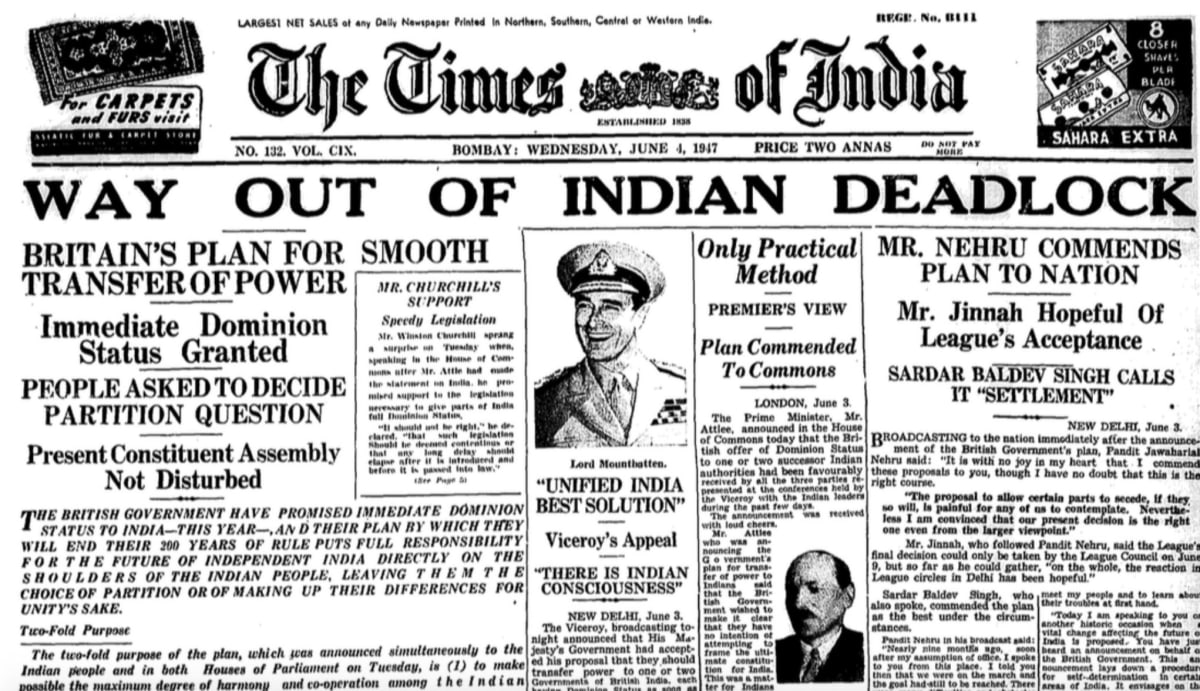
(i) Name the Viceroy who announced the plan for smooth transfer of power. Mention any two clauses of his plan with reference to the Princely States.
(ii) Mention any three reasons for the acceptance of his plan by the Congress.
(iii) Mention any four provisions of the Indian Independence Act of 1947.
Both the United Nations Organisation and the Non-Aligned Movement aim to achieve international peace and security. In this context, answer the following:
(i) Mention any three functions of the Security Council.
(ii) Mention any three functions of the World Health Organisation.
(iii) Name any two founders of the Non-Aligned Movement. Mention any two of its objectives.