
Physics
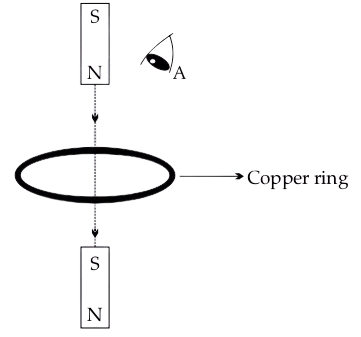
The following figure shows a small bar magnet falling freely through a copper ring. For the observer at A, the direction of the induced current will be :
- clockwise when magnet is above and below the ring
- anticlockwise when magnet is above and below the ring
- anticlockwise when magnet is above the ring and clockwise when the magnet is below the ring
- clockwise when magnet is above the ring and anticlockwise when the magnet is below the ring
Electro-Magnetism
20 Likes
Answer
anticlockwise when magnet is above the ring and clockwise when the magnet is below the ring
Reason
Magnet above the ring (approaching it)
Flux change The north pole of the magnet faces the ring, so magnetic field lines enter the ring downwards. As the magnet falls closer, the downward flux through the ring increases.
Opposition required To oppose this increase in downward flux, the ring must create an upward field (its own north pole must face the magnet).
Current direction Using the right-hand rule, a coil whose top acts as a north pole carries anticlockwise current when viewed from above.
Result: Anticlockwise current while the magnet is above the ring.
Magnet inside and leaving the ring (moving away below it)
Flux change Once the magnet has passed through, the same downward field lines are now moving away, so the downward flux decreases.
Opposition required The ring tries to maintain the original flux by producing more downward field—i.e., its top must now behave like a south pole.
Current direction A coil whose top is a south pole carries clockwise current when viewed from above.
Result: Clockwise current while the magnet is below the ring.
Answered By
9 Likes
Related Questions
A radioactive element P emits one α-particle and transforms to a new element Q. What will be the position of the element Q in the periodic table?
- One group to the left of P
- One group to the right of P
- Two groups to the right of P
- Two groups to the left of P
Each of the substances given below is supplied with same amount of heat. Which one will attain the highest temperature?
Substance Specific heat capacity (cal/g°C) Lead 0.031 Aluminium 0.21 Copper 0.095 Iron 0.115 - Aluminium
- Copper
- Iron
- Lead
Complete the following by choosing the correct answers from the bracket:
(a) In uniform circular motion the centrifugal force acts …………… [towards the centre/away from the centre/along the tangential direction].
(b) Refractive index of a medium is independent of …………… [temperature/angle of incidence/wavelength of light].
(c) Heat absorbed during change of phase depends on …………… [mass/change in temperature/specific heat capacity] of the substance.
(d) Emf of a cell is …………… [greater than/less than/equal to] the terminal voltage when the cell is in open circuit.
(e) In a step-up transformer the turns ratio is …………… [more than 1/ less than 1/ equal to 1].
(f) The nuclear radiation with lowest ionising power is …………… [α/β/γ]
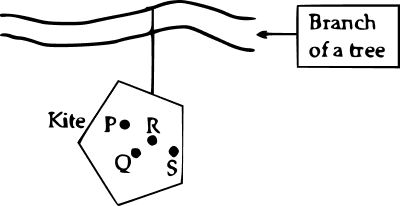
A non-uniform kite is hanging freely from the branch of a tree as shown. Study the figure and answer the following :
(a) Fill in the blank.
…………… [P, Q, R or S] is the most probable position of its centre of gravity.
(b) Support your answer to (a) with a reason