
Physics
A non-uniform kite is hanging freely from the branch of a tree as shown. Study the figure and answer the following :

(a) Fill in the blank.
…………… [P, Q, R or S] is the most probable position of its centre of gravity.
(b) Support your answer to (a) with a reason
Force
39 Likes
Answer
(a) R is the most probable position of its centre of gravity.
(b) When a body is freely suspended from a point, it comes to rest (i.e. stops oscillating) in such a position that its centre of gravity lies vertically below the point of suspension. So, in the figure, the string from the branch passes vertically through point R, hence R is the most probable position of the kite’s centre of gravity.
Answered By
21 Likes
Related Questions
The following figure shows a small bar magnet falling freely through a copper ring. For the observer at A, the direction of the induced current will be :
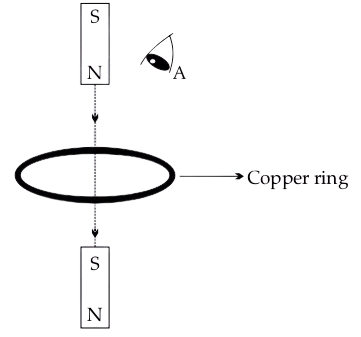
- clockwise when magnet is above and below the ring
- anticlockwise when magnet is above and below the ring
- anticlockwise when magnet is above the ring and clockwise when the magnet is below the ring
- clockwise when magnet is above the ring and anticlockwise when the magnet is below the ring
Complete the following by choosing the correct answers from the bracket:
(a) In uniform circular motion the centrifugal force acts …………… [towards the centre/away from the centre/along the tangential direction].
(b) Refractive index of a medium is independent of …………… [temperature/angle of incidence/wavelength of light].
(c) Heat absorbed during change of phase depends on …………… [mass/change in temperature/specific heat capacity] of the substance.
(d) Emf of a cell is …………… [greater than/less than/equal to] the terminal voltage when the cell is in open circuit.
(e) In a step-up transformer the turns ratio is …………… [more than 1/ less than 1/ equal to 1].
(f) The nuclear radiation with lowest ionising power is …………… [α/β/γ]
The displacement–time graph of a sound wave produced by a vibrating wire is shown below.
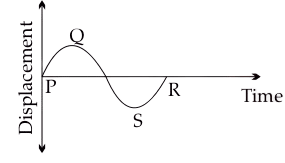
(a) How will you adjust the tension in the wire, to reduce the length of PR?
(b) Which characteristic of sound is affected by the reduction in the length of PR?
A ray of light enters a rectangular glass slab submerged in water at an angle of incidence 55°. Does this ray undergo total internal reflection when it moves from water to glass? Justify your answer. (The critical angle for glass–water interface is 54°)