
Mathematics
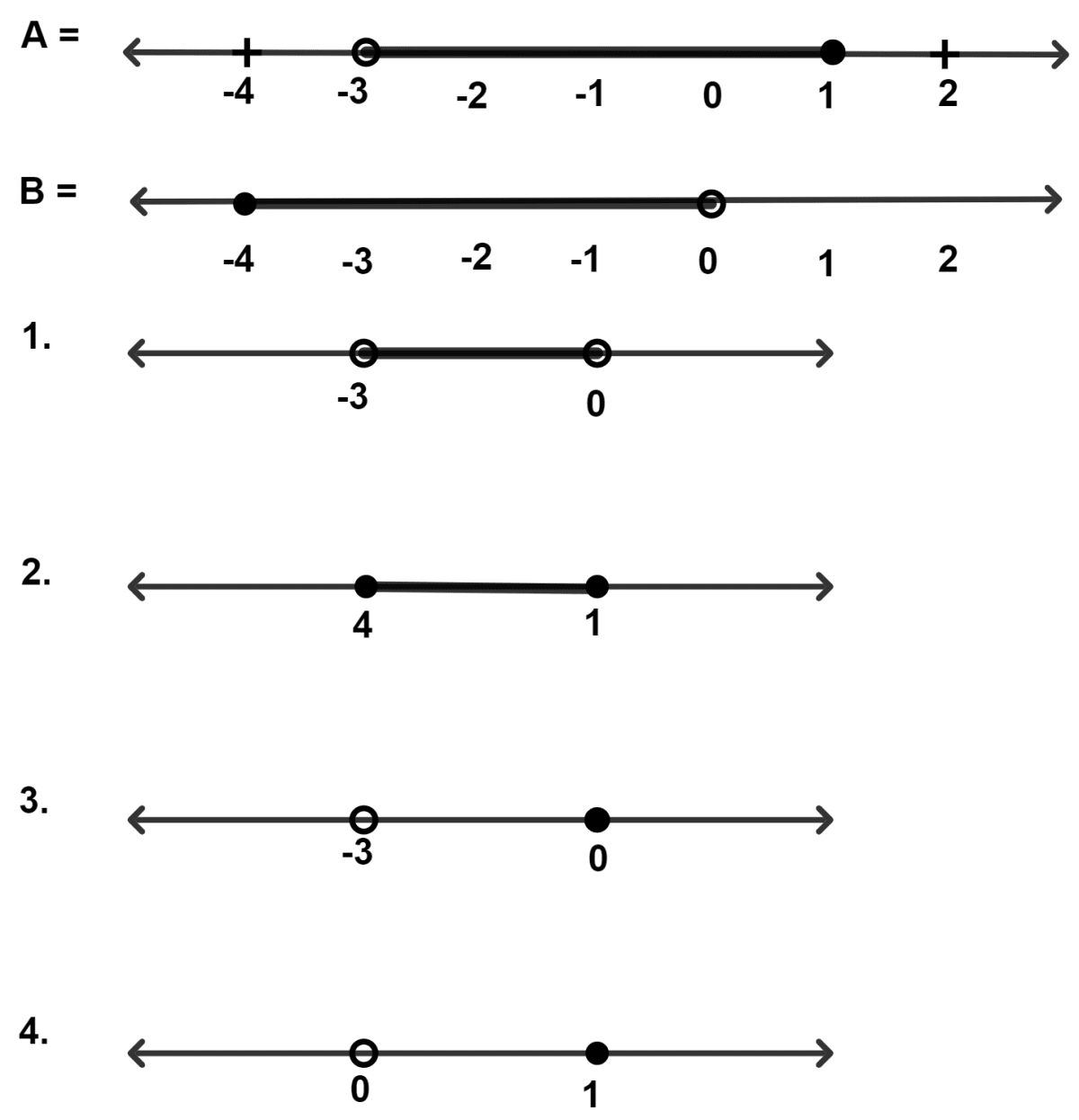
For the inequations A and B [as given above in part (d)], A ∪ B is :
![For the inequations A and B [as given above in part (d)], A ∪ B is : Linear Inequations, Concise Mathematics Solutions ICSE Class 10.](https://cdn1.knowledgeboat.com/img/cm10/q1-e-test-linear-inequations-maths-concise-icse-class-10-solutions-1126x1099.png)
Linear Inequations
9 Likes
Answer
A = {x : x ∈ R and -3 < x ≤ 1}
B = {x : x ∈ R and -4 ≤ x < 0}
A ∪ B = {x : x ∈ R and -4 ≤ x ≤ 1}
Hence, Option 1 is the correct option.
Answered By
4 Likes
Related Questions
The value of x for the inequation 3x + 15 < 5x + 13, x ∈ Z is :
x > 1
x < 1
x = 1
x ≥ 1
The real number lines for two inequations A and B are as given below, A ∩ B is :
where x ∈ R.
Assertion (A): The largest value of x is .
Reason (R): When the signs of both the sides of an inequalities are changed, the sign of inequality reverses.
A is true, R is false.
A is false, R is true.
Both A and R are true and R is the correct reason for A.
Both A and R are true and R is the incorrect reason for A.
Inequation 5 - 2x ≥ x - 10, where x ∈ N (Natural numbers)
Assertion (A): 5 - 2x ≥ x - 10 ⇒ -3x ≥ -15 ⇒ x ≥ 5
∴ Solution set = {5, 6, 7, 8, ……….}
Reason (R): 5 - 2x ≥ x - 10 ⇒ 5 + 10 ≥ 3x ⇒ x ≤ 5
∴ Solution set = {1, 2, 3, 4, 5}
A is true, R is false.
A is false, R is true.
Both A and R are true and R is correct reason for A.
Both A and R are true and R is incorrect reason for A.