Mathematics
Given that ΔABC ∼ ΔPQR.
(i) If ar(ΔABC) = 49 cm2 and ar(ΔPQR) = 25 cm2 and AB = 5.6 cm, find the length of PQ.
(ii) If ar(ΔABC) = 28 cm2 and ar(ΔPQR) = 63 cm2 and PR = 8.4 cm, find the length of AC.
(iii) If BC = 4 cm, QR = 5 cm and ar(ΔABC) = 32 cm2 determine ar(ΔPQR).
Similarity
2 Likes
Answer
(i) Given,
ΔABC ∼ ΔPQR
ar(ΔABC) = 49 cm2
ar(ΔPQR) = 25 cm2
AB = 5.6 cm
We know that,
The ratio of the areas of two similar triangles is equal to the square of the ratio of their corresponding sides.
Hence, PQ = 4 cm.
(ii) Given,
ΔABC ∼ ΔPQR
ar(ΔABC) = 28 cm2
ar(ΔPQR) = 63 cm2
PR = 8.4 cm
We know that,
The ratio of the areas of two similar triangles is equal to the square of the ratio of their corresponding sides.
Hence, AC = 5.6 cm.
(iii) Given,
ΔABC ∼ ΔPQR
BC = 4 cm
QR = 5 cm
ar(ΔABC) = 32 cm2
We know that,
The ratio of the areas of two similar triangles is equal to the square of the ratio of their corresponding sides.
Hence, ar(ΔPQR) = 50 cm2.
Answered By
2 Likes
Related Questions
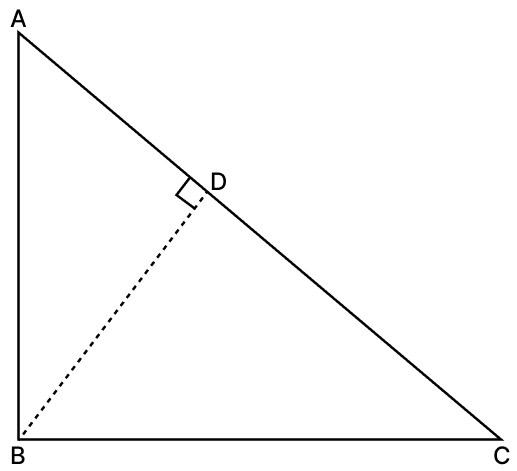
In the given figure, ∠ABC = 90° and BD ⟂ AC. If AB = 5.7 cm, BD = 3.8 cm and CD = 5.4 cm, find BC.
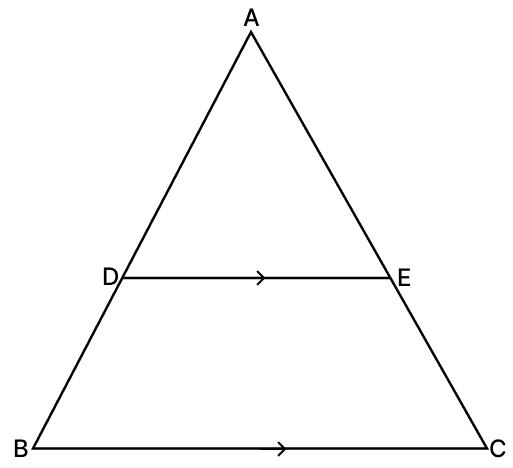
In the given figure, DE ∥ BC.
(i) Prove that ΔADE ∼ ΔABC.
(ii) Given that AD = DB, calculate DE, if BC = 4.5 cm.
(iii) Find .
(iv) Find .
The areas of two similar triangles are 48 cm2 and 75 cm2 respectively. If the altitude of the first triangle is 3.6 cm, find the corresponding altitude of the other.
In the given figure, AB ⟂ BC and DE ⟂ BC. If AB = 9 cm, DE = 3 cm and AC = 24 cm, calculate AD.