
Biology
Given alongside is the figure of a median section of an organ. Study the same and answer the following questions :
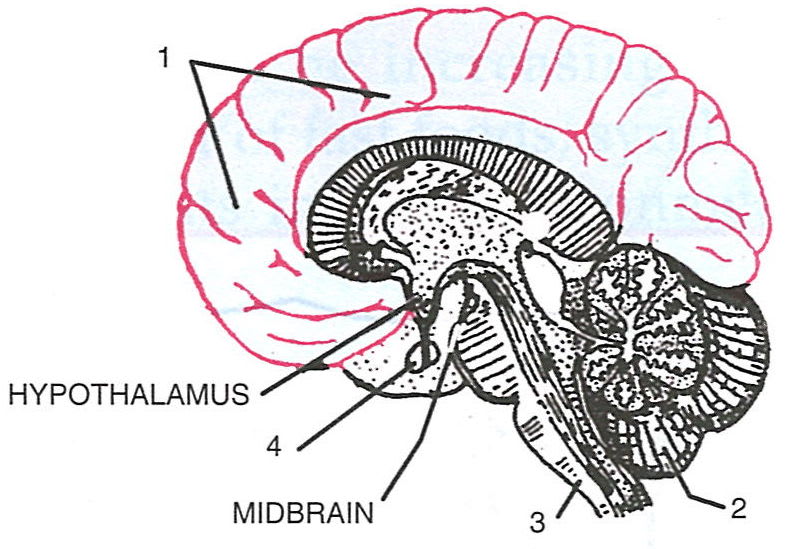
- Name the organ and write its location in our body.
- Label the guidelines 1 to 4.
- Write one important function of hypothalamus.
- Which of the structures from 1 to 4 is considered as the master gland of the body ?
- Mention the basic structural unit of the organ shown in the figure and the organ system to which it belongs.
Nervous System
28 Likes
Answer
The organ shown in the given figure is the human brain. It is contained in, and protected by, a bony structure called the skull or the cranium. The brain is further enclosed in three protective membranes, collectively called as meninges, which are separated by cerebrospinal fluid.
The guidelines 1 to 4 show:
1 → Cereberal hemisphere
2 → Cerebellum
3 → Medulla Oblongata
4 → PituitaryOne important function of the hypothalamus is regulating body temperature. It acts as the body's thermostat, monitoring internal temperature and initiating responses like sweating or shivering to maintain a stable internal environment.
The pituitary gland is often called the "master gland" of the human body because it produces hormones that regulate many other glands and bodily functions.
The basic structural and functional unit of the brain is the neuron (also known as a nerve cell). Neurons belong to the nervous system.
Answered By
15 Likes
Related Questions
Distinguish between the following pairs on the basis of the words indicated in the brackets [].
Motor and Mixed nerves. [Kind of neurons]
Draw a neat and labelled diagram of a nerve cell.
A part of our nervous system is shown alongside. Study the same and answer the following questions :
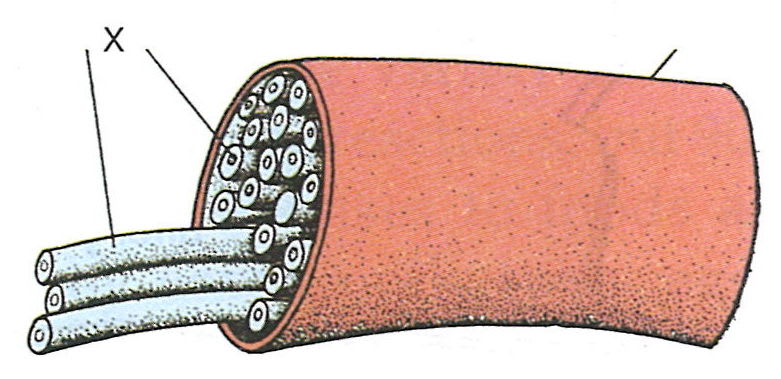
- Identify the figure and name it.
- Define the structure shown.
- Label the part shown as X.
- Write the name of the protective, tubular covering of the structure shown.
- Mention the names of the three kinds of the structure that is shown in the figure.
Briefly describe the structure of the cerebrum in human brain and mention its functions.