
Mathematics
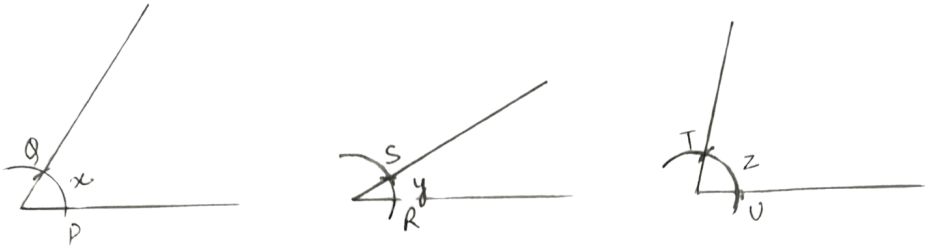
Given below are the angles x, y and z.

Without measuring these angles construct :
(i) ∠ABC = x + y + z
(ii) ∠ABC = 2x + y + z
(iii) ∠ABC = x + 2y + z
Quadrilaterals Constructions
2 Likes
Answer
(i) Steps:
Draw line segment BC of any suitable length.
With B as centre, draw an arc of any suitable radius. With the same radius, draw arcs with the vertices of given angles as centres. Let these arcs cut arms of the angle x at the points Q and P, arms of the angle y at points S and R and arms of the angles z at points T and U.
From the arc, with centre B, cut MN = PQ = x, NO = SR = y and OX = TU = z.
Joint BX and produce upto point A.
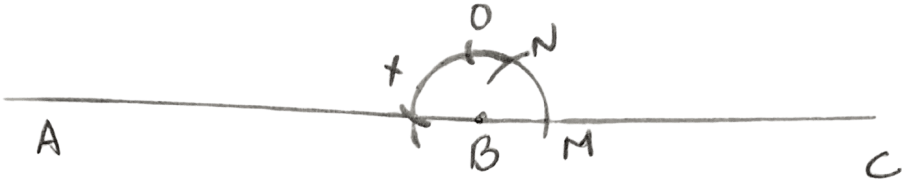
Hence, ∠ ABC = x + y + z.
(ii) Steps:
Draw line segment BC of any suitable length.
With B as centre, draw an arc of any suitable radius. With the same radius, draw arcs with the vertices of given angles as centres. Let these arcs cut arms of the angle x at the points P and Q, arms of the angles y at points R and S and arms of the angles z by at the points T and U.
From the arc, with centre B, cut MN = PQ = x, NO = PQ = x , OX = RS = y and XY = TU = z.
Joint BY and produce upto point A.
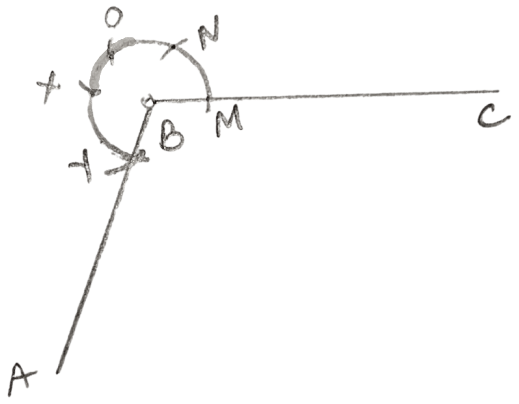
Hence, ∠ABC = 2x + y + z.
(iii) Steps:
Draw line segment BC of any suitable length.
With B as centre, draw an arc of any suitable radius. With the same radius, draw arcs with the vertices of given angles as centres. Let these arcs cut arms of the angle x at the points P and Q, arms of the angle y at points R and S, and arms of the angle z at points T and U.
From the arc, with centre B, cut MN = PQ = x, NO = SR = y, OX = SR = y and XY = TU = z.
Joint BY and produce upto point A.
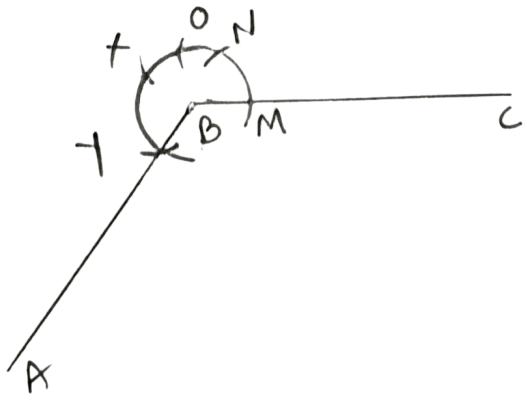
Hence, ∠ABC = x + 2y + z.
Answered By
1 Like
Related Questions
A parallelogram will not be a rhombus if :
sum of its opposite angles is 180°
its adjacent sides are equal.
its diagonals are perpendicular to each other.
each diagonal bisects the angles of the vertices.
A rectangle will not be a square, if :
adjacent sides are equal
angle between the diagonals is 90°
diagonals bisect each other and the angle between them is not 90°
all its sides are equal.
Draw a line segment AB = 6.2 cm. Mark a point P in AB such that BP = 4 cm. Through point P draw a perpendicular to AB.
Construct an angle ABC = 90°. Locate a point P which is 2.5 cm from AB and 3.2 cm from BC.