
Mathematics
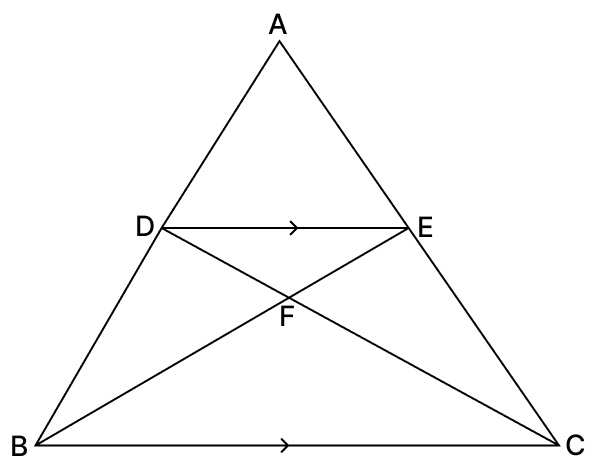
In the given diagram, DE || BC and AD : DB = 2 : 3.
(a) Prove that : ΔADE ~ ΔABC and hence find DE : BC.
(b) Prove : ΔDFE ~ ΔCFB
(c) Given, area of ΔDFE = 16 square units, find the area of ΔCFB.
Similarity
1 Like
Answer
(a) Given,
DE ∥ BC
In triangle △ADE and △ABC,
∠ADE = ∠ABC (Corresponding angles are equal)
∠AED = ∠ACB (Corresponding angles are equal)
Therefore, △ADE ∼ △ABC (By AA similarity)
Given,
AD : DB = 2 : 3
Let AD = 2x and DB = 3x.
From figure,
AB = AD + DB = 2x + 3x = 5x.
We know that,
Corresponding sides of similar triangle are in proportion.
.
DE : BC = 2 : 5.
Hence, proved ΔADE ~ ΔABC and DE : BC = 2 : 5.
(b) Given,
DE ∥ BC
In triangle ΔDFE and ΔCFB,
∠DFE = ∠CFB (Vertically opposite angles are equal)
∠DEF = ∠CBF (Alternate interior angles are equal)
ΔDFE ~ ΔCFB [By AA similarity]
Hence, proved that ΔDFE ~ ΔCFB.
(c) Let area of ΔCFB be x square units.
We know that,
The areas of two similar triangles are proportional to the squares of their corresponding sides.
Hence, area of △CFB = 100 sq.units.
Answered By
3 Likes
Related Questions
Prove that :
(sec θ − cos θ)(cosec θ − sin θ) = sin θ cos θ
The cost price of a TV set is ₹ 20,000. The shopkeeper marked it for ₹ 24,000. He sells it to a customer at a discount of 10% on the marked price. If the sale is intra-state and the rate of GST is 12%, find the:
(a) discounted price of the TV set.
(b) amount paid by the customer to clear the bill.
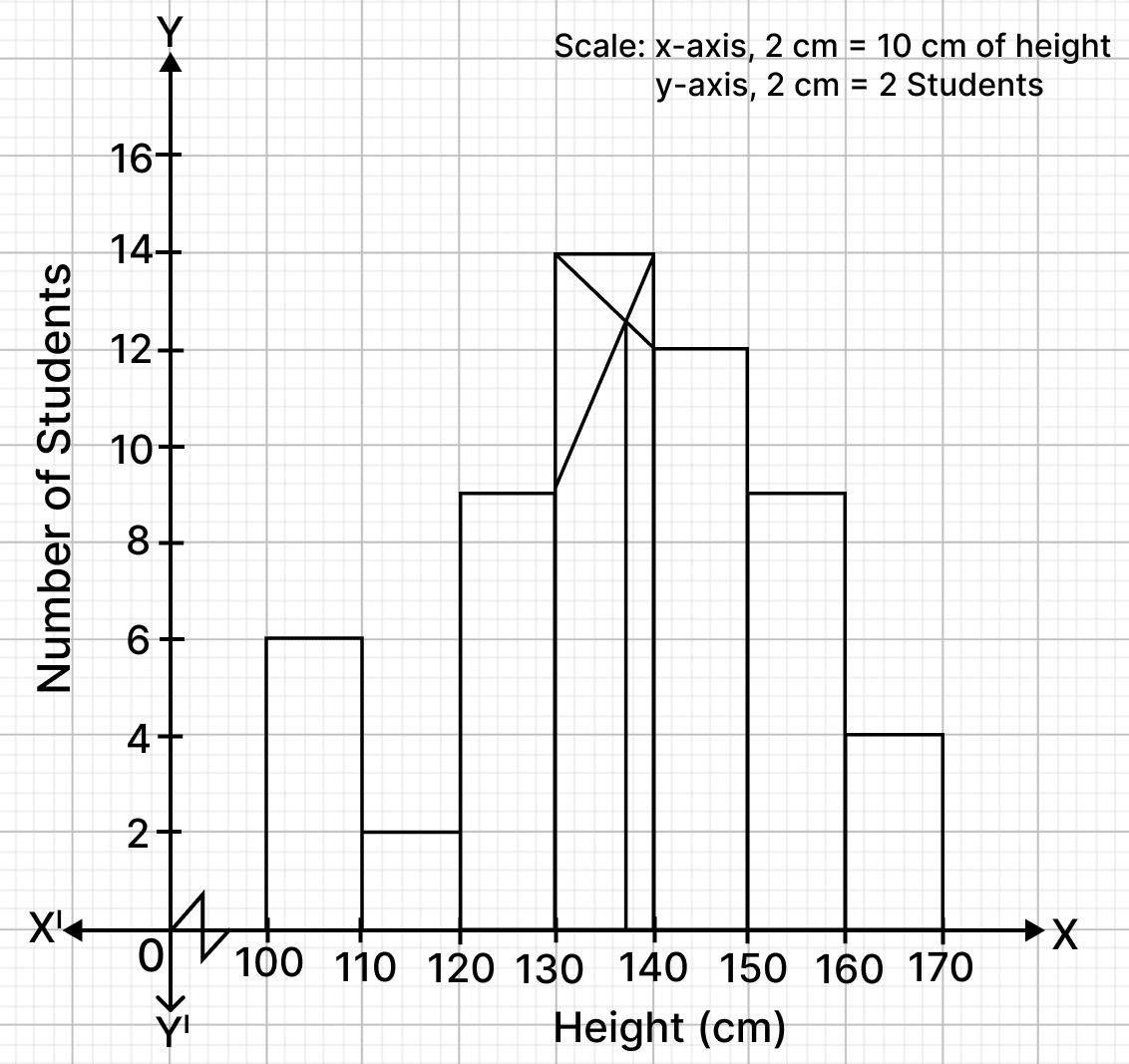
The histogram drawn on the graph represents the number of students of different heights (in cm).
Using the graph, answer the following :
(a) the number of students whose height is 150 cm and above.
(b) the modal height.
(c) the total number of students.
A(−10, −2) and B(2, 10) are two end points of a line segment. If AB intersects the x-axis at P, find the :
(a) ratio in which ‘P’ divides AB.
(b) coordinates of point P.