
Mathematics
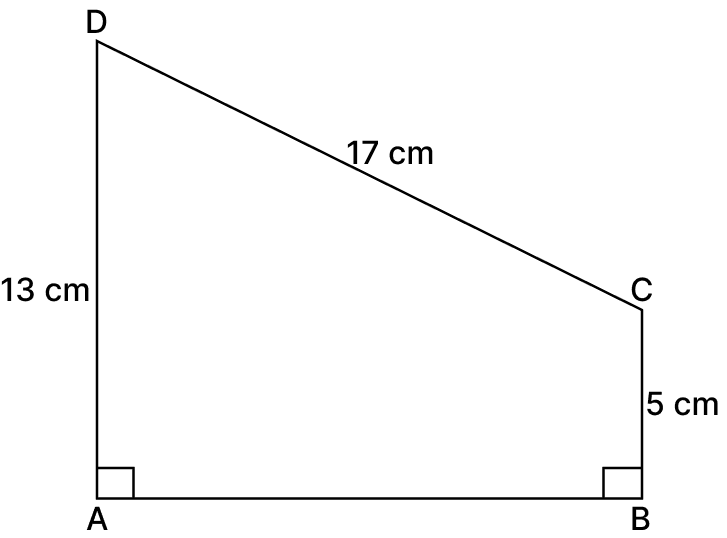
In the given figure, ABCD is a trapezium in which AD = 13 cm, BC = 5 cm, CD = 17 cm and ∠A = ∠B = 90°. Calculate :
(i) AB
(ii) Area of trap. ABCD
Mensuration
2 Likes
Answer
(i) Draw CE ⊥ AD.
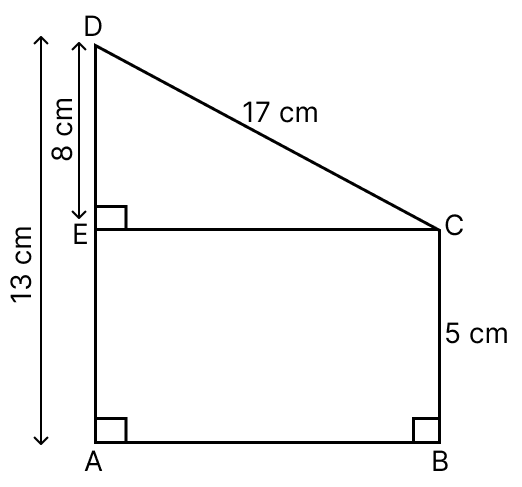
∴ DE = 13 - 5 = 8 cm.
In triangle DEC,
By pythagoras theorem,
⇒ CD2 = EC2 + DE2
⇒ 172 = EC2 + 82
⇒ EC2 = 172 - 82
⇒ EC2 = 289 - 64
⇒ EC2 = 225
⇒ EC =
⇒ EC = 15 cm
From figure,
AB = EC = 15 cm.
Hence, AB = 15 cm.
(ii) Area of trapezium = × (sum of parallel sides) × distance between them
= × (AD + BC) × EC
= × (13 + 5) × 15
= × 18 × 15
= 9 × 15 = 135 cm2.
Hence, area of trapezium = 135 cm2.
Answered By
2 Likes
Related Questions
The area of a rhombus is 216 cm2 and one of its diagonals measures 24 cm. Find:
(i) the length of the other diagonal,
(ii) the length of each of its sides,
(iii) its perimeter.
Two adjacent sides of a parallelogram are 36 cm and 25 cm. If the distance between longer sides is 15 cm, find the distance between the shorter sides.
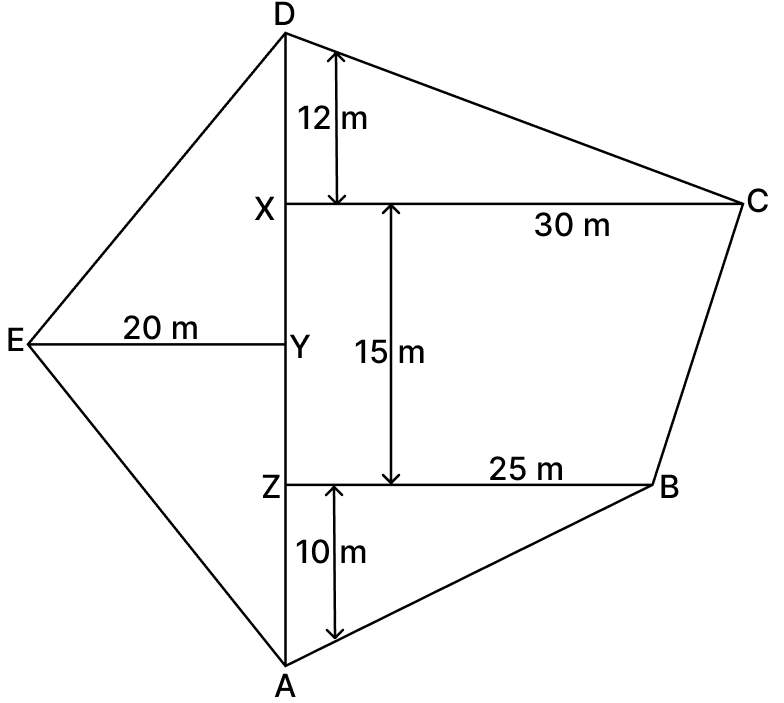
The adjoining figure shows a field with the measurement given in metres. Find the area of the field.
The area of an equilateral triangle is cm2. The length of its each side is :
4 cm
6 cm
8 cm
9 cm