Mathematics
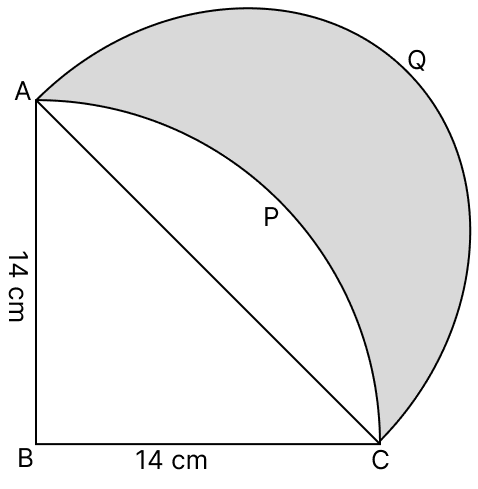
In the given figure, ABCP is a quadrant of a circle of radius 14 cm. With AC as diameter, a semi-circle is drawn. Find the area of shaded region.
Mensuration
1 Like
Answer
Given,
ABCP is a quadrant of radius = 14 cm
AB = BC = 14 cm
AC is the diameter of semicircle.
Using Pythagoras theorem in △ABC,
⇒ AC2 = AB2 + BC2
⇒ AC2 = 142 + 142
⇒ AC2 = 196 + 196
⇒ AC2 = 392
⇒ AC = cm.
So, radius of semicircle = cm.
Calculating area of semicircle :
Calculating area of quadrant :
Calculating area of triangle :
Area of triangle ABC = × AB × BC
= × 14 × 14
= 7 × 14 = 98 cm2.
Shaded area = (Area of semicircle AQC) - [(Area of quadrant APCB) - (Area of triangle ABC)]
Area of shaded region = 154 - [(154 - 98)]
= 154 - 56 = 98 cm2.
Hence, area of shaded region = 98 cm2.
Answered By
2 Likes
Related Questions
Find the perimeter and area of the shaded region shown in the figure. The four corners are circle quadrants and at the centre, there is a circle.
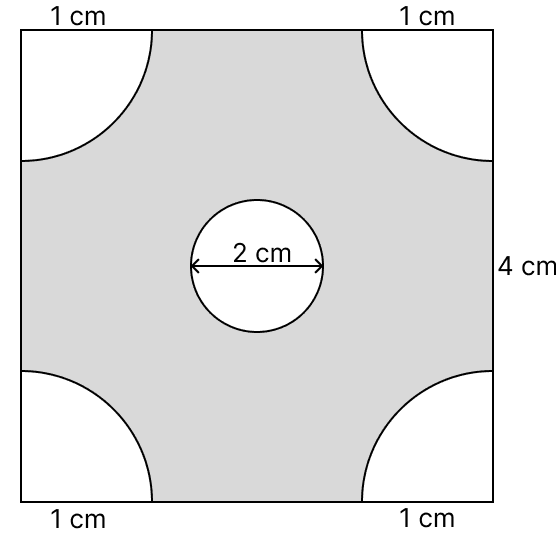
Find the perimeter and area of the shaded region in the given figure.
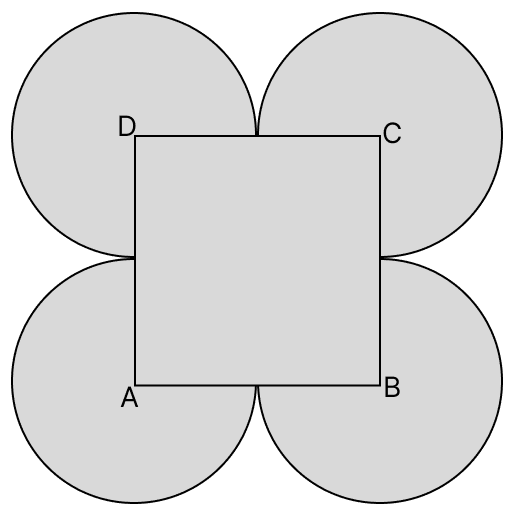
In the given figure, ABCD is a square of side 14 cm and A, B, C, D are centres of circular arcs, each of radius 7 cm. Find the area of shaded region.
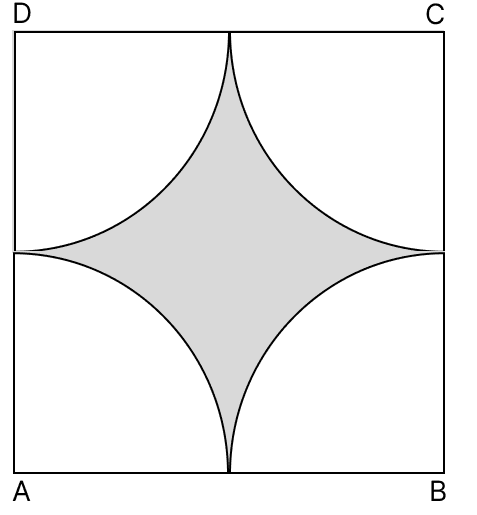
In the given figure, ABCD is a square of side 7 cm and A, B, C, D are centres of equal circles which touch externally in pairs. Find the area of the shaded region.