Mathematics
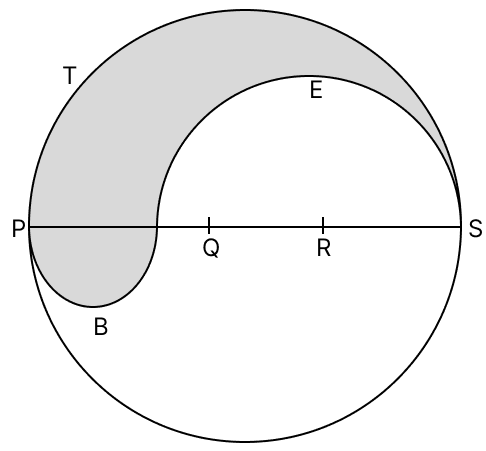
In the given figure, PQRS is a diameter of a circle of radius 6 cm. The lengths PQ, QR and RS are equal. Semi-circles are drawn on PQ and QS as diameters. If PS = 12 cm, find the perimeter and the area of the shaded region.
Mensuration
1 Like
Answer
Given,
PS = 12 cm
PQ = QR = RS = = 4 cm, QS = 8 cm.
Perimeter of shaded region = Arc PTS + Arc PBQ + Arc QES
Radius of semi-circle PTS = = 6 cm.
Arc PTS = × 2π.radius
= πr
= 3.14 × 6 = 18.84 cm.
Radius of semi-circle PBQ = = 2 cm.
Arc PBQ = π.radius
= 3.14 × 2 = 6.28 cm.
Radius of semi-circle QES = = 4 cm.
Arc QES = π.radius
= 3.14 × 4 = 12.56 cm.
Perimeter of shaded region = Arc PTS + Arc PBQ + Arc QES
= 18.84 + 6.28 + 12.56
= 37.68 cm.
Area of shaded region = Area of big semicircle + Area of small semicircle on PQ - Area of semicircle on QS
Calculating area of big semicircle,
Area of small semicircle on PQ = π.(radius)2
= × 3.14 × 2^2
= 3.14 × 2 = 6.28 cm2.
Area of semicircle on QS = π.(radius)2
= × 3.14 × 42
= 3.14 × 8 = 25.12 cm2
Area of shaded region = 56.52 + 6.28 - 25.12
= 37.68 cm2.
Hence, area of shaded region = 37.68 cm2 and perimeter = 37.68 cm.
Answered By
1 Like
Related Questions
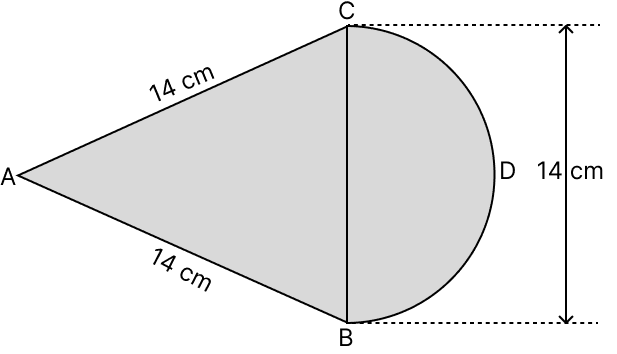
In an equilateral △ABC of side 14 cm, side BC is the diameter of a semi-circle as shown in the figure. Find the area of the shaded region.
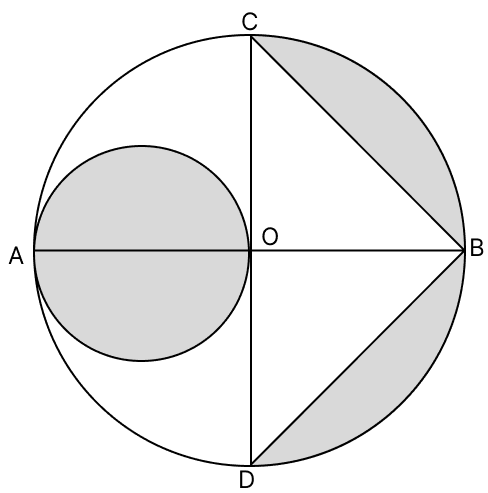
In the given figure, AB is the diameter of a circle with centre O and OA = 7 cm. Find the area of the shaded region.
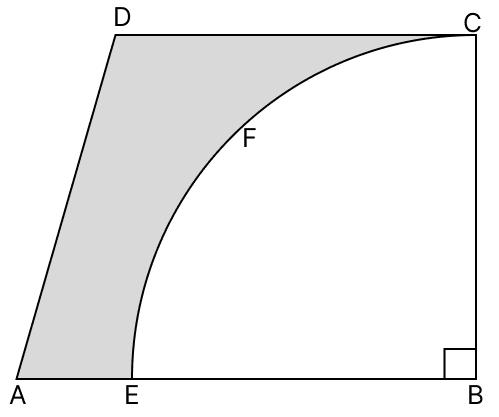
In the given figure, ABCD is a piece of cardboard in the shape of trapezium in which AB || DC, ∠ABC = 90°. From this piece, quarter circle BEFC is removed. Given DC = BC = 4.2 cm and AE = 2 cm. Calculate the area of the remaining piece of the cardboard.
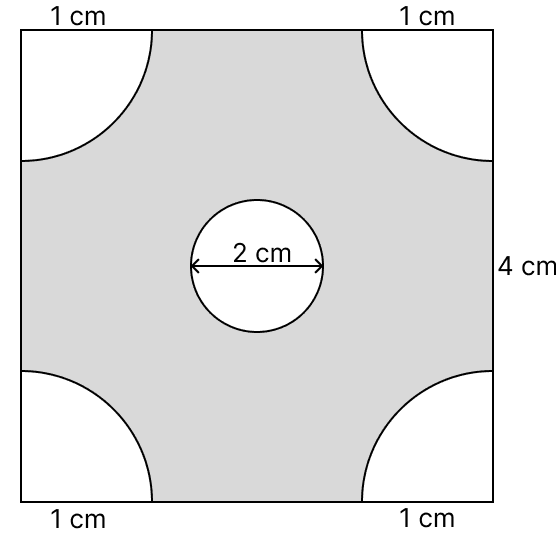
Find the perimeter and area of the shaded region shown in the figure. The four corners are circle quadrants and at the centre, there is a circle.