
Mathematics
Given the equations of two straight lines, L1 and L2 are x - y = 1 and x + y = 5 respectively. If L1 and L2 intersects at point Q (3, 2). Find :
(a) the equation of line L3 which is parallel to L1 and has y-intercept 3.
(b) the value of k, if the line L3 meets the line L2 at a point P (k, 4).
(c) the coordinate of R and the ratio PQ : QR, if line L2 meets x-axis at point R.
Straight Line Eq
54 Likes
Answer
(a) L1 : x - y = 1
⇒ y = x - 1
Comparing above equation with y = mx + c, we get :
⇒ m = 1.
We know that,
Slope of parallel lines are equal.
∴ Slope of L3 = 1.
Given,
L3 has y-intercept = 3.
∴ y = mx + c
⇒ y = 1.x + 3
⇒ y = x + 3.
Hence, equation of line L3 : y = x + 3.
(b) L2 : x + y = 5 and L3 : y = x + 3
⇒ x + y = 5 ………(1)
⇒ y = x + 3 ………(2)
Substituting value of y from equation (2) in (1), we get :
⇒ x + (x + 3) = 5
⇒ 2x + 3 = 5
⇒ 2x = 5 - 3
⇒ 2x = 2
⇒ x =
⇒ x = 1.
Substituting value of x in equation (2), we get :
⇒ y = 1 + 3 = 4.
⇒ (x, y) = (1, 4)
∴ P(k, 4) = (1, 4)
Hence, value of k = 1.
(c) Given,
L2 meets x-axis at point R.
At point on x-axis, y-coordinate = 0.
L2 : x + y = 5
⇒ x + 0 = 5
⇒ x = 5
⇒ R = (x, y) = (5, 0).
P = (1, 4), Q = (3, 2) and R = (5, 0)
Let PQ : QR = k : 1
By section formula,
∴ PQ : QR = 1 : 1.
Hence, R = (5, 0) and PQ : QR = 1 : 1.
Answered By
16 Likes
Related Questions
Using remainder and factor theorem, show that (2x + 3) is a factor of the polynomial 2x2 + 11x + 12. Hence, factorise it completely. What must be multiplied to the given polynomial so that x2 + 3x - 4 is a factor of the resulting polynomial? Also, write the resulting polynomial.
The sequence 2, 9, 16, ….. is given.
(a) Identify if the given sequence is an AP or a GP. Give reasons to support your answer.
(b) Find the 20th term of the sequence.
(c) Find the difference between the sum of its first 22 and 25 terms.
(d) Is the term 102 belong to this sequence?
(e) If ‘k’ is added to each of the above terms, will the new sequence be in A.P. or G.P.?
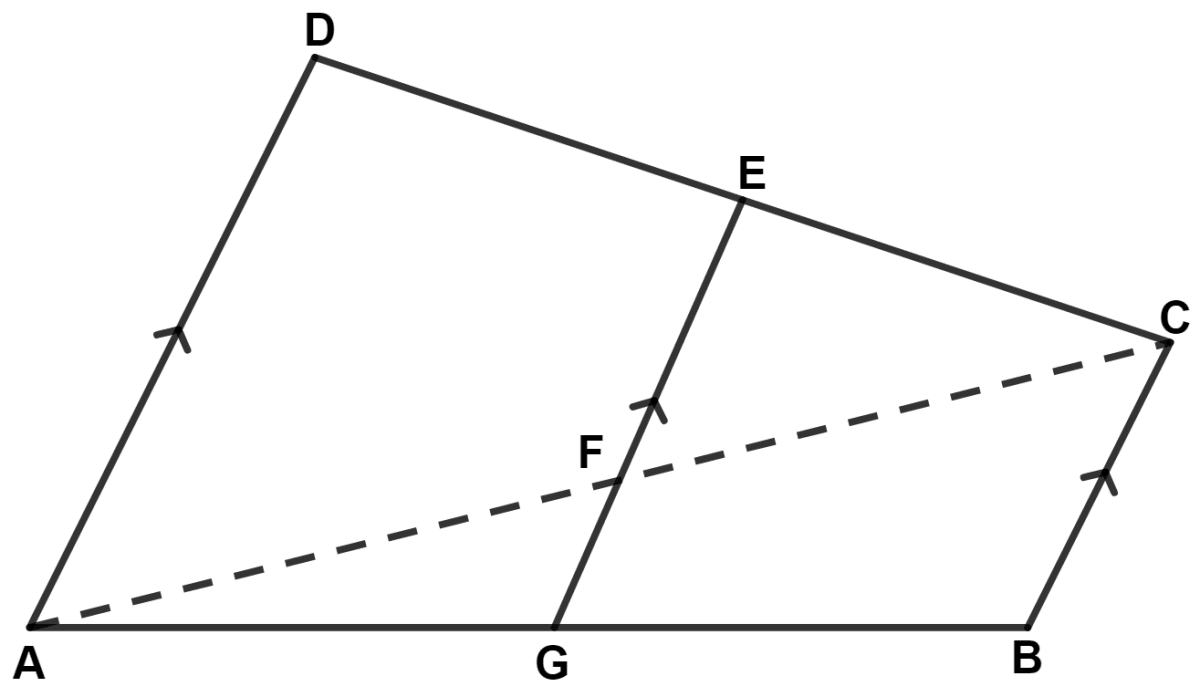
In the figure given below (not drawn to scale), AD ∥ GE ∥ BC, DE = 18 cm, EC = 3 cm, AD = 35 cm. Find :
(a) AF : FC
(b) length of EF
(c) area(trapezium ADEF) : area(Δ EFC)
(d) BC ∶ GF
(a) Construct the locus of a moving point which moves such that it keeps a fixed distance of 4.5 cm from a fixed-point O.
(b) Draw line segment AB of 6 cm where A and B are two points on the locus (a).
(c) Construct the locus of all points equidistant from A and B. Name the points of intersection of the loci (a) and (c) as P and Q respectively.
(d) Join PA. Find the locus of all points equidistant from AP and AB.
(e) Mark the point of intersection of the locus (a) and (d) as R. Measure and write down the length of AR.
(Use a ruler and a compass for this question.)