
Mathematics
(a) Construct the locus of a moving point which moves such that it keeps a fixed distance of 4.5 cm from a fixed-point O.
(b) Draw line segment AB of 6 cm where A and B are two points on the locus (a).
(c) Construct the locus of all points equidistant from A and B. Name the points of intersection of the loci (a) and (c) as P and Q respectively.
(d) Join PA. Find the locus of all points equidistant from AP and AB.
(e) Mark the point of intersection of the locus (a) and (d) as R. Measure and write down the length of AR.
(Use a ruler and a compass for this question.)
Locus
49 Likes
Answer
We know that,
Locus of a point at a fixed distance from a fixed point is the circumference of the circle with fixed point as center and fixed distance as radius.
Steps of construction :
Mark point O.
With center O and radius = 4.5 cm draw a circle.
Use a ruler to mark point A.
From point A, measure 6 cm along a straight line and mark point B.
Draw a straight line connecting points A and B.
We know that, locus of points equidistant from two points is the perpendicular bisector of the line joining the two points.Draw perpendicular bisector of AB.
Mark the points P and Q where the perpendicular bisector intersects circle.
We know that, locus of points equidistant from two lines is the angle bisector of the angle between the lines.Join PA.
Draw AX, the angle bisector of ∠A.
Mark point R as the intersection point of AX on the circumference of the circle.
Measure AR.
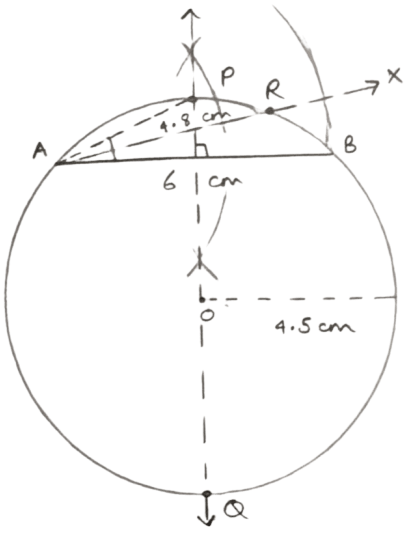
Hence, AR = 4.8 cm.
Answered By
28 Likes
Related Questions
Given the equations of two straight lines, L1 and L2 are x - y = 1 and x + y = 5 respectively. If L1 and L2 intersects at point Q (3, 2). Find :
(a) the equation of line L3 which is parallel to L1 and has y-intercept 3.
(b) the value of k, if the line L3 meets the line L2 at a point P (k, 4).
(c) the coordinate of R and the ratio PQ : QR, if line L2 meets x-axis at point R.
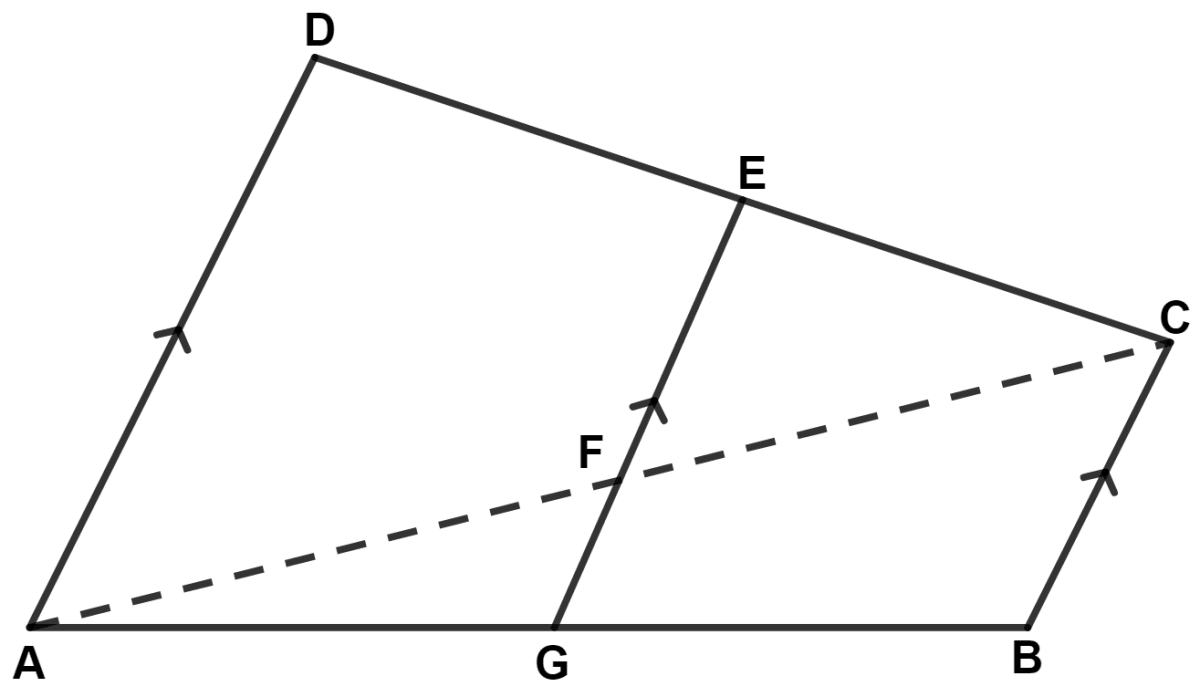
In the figure given below (not drawn to scale), AD ∥ GE ∥ BC, DE = 18 cm, EC = 3 cm, AD = 35 cm. Find :
(a) AF : FC
(b) length of EF
(c) area(trapezium ADEF) : area(Δ EFC)
(d) BC ∶ GF
Construct a regular hexagon ABCDEF of side 4.3 cm and construct its circumscribed circle. Also, construct tangents to the circumscribed circle at points B and C which meets each other at point P. Measure and record ∠BPC.
(Use a ruler and a compass for this question.)
A mathematics teacher uses certain amount of terracotta clay to form different shaped solids. First, she turned it into a sphere of radius 7 cm and then she made a right circular cone with base radius 14 cm. Find the height of the cone so formed. If the same clay is turned to make a right circular cylinder of height cm, then find the radius of the cylinder so formed. Also, compare the total surface areas of sphere and cylinder so formed.