Physics
In the graph, a given quantity of ice is converted to water.
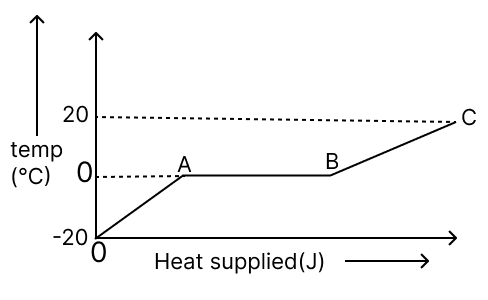
(a) What does the portion AB represent?
(b) Why is the portion AB parallel to the time axis?
(c) Why is the slope OA steeper than the slope BC?
Answer
(a) Melting of ice.
(b) During the melting of ice, the temperature remains constant, even though heat is supplied, until all the ice has converted into water. This is because the supplied heat is used to overcome the intermolecular forces holding the ice molecules together, rather than increasing their kinetic energy.
(c) As specific heat capacity of ice is less than specific heat capacity of water. Hence, ice needs less quantity of heat than water for the same rise of temperature.
Related Questions
You are doing an experiment on the refraction of light in your Physics laboratory. ABCD is a rectangular block. A ray of light is incident obliquely on the surface AB.
(a) Draw the path of the ray of light through the glass block and also show how it emerges from the block. [ The diagram should show the lateral displacement suffered by the ray.]
(b) Which two pairs of angles remain the same during the experiment?
(c) If the same experiment is performed first with red and then with blue light, which colour will suffer greater lateral displacement?
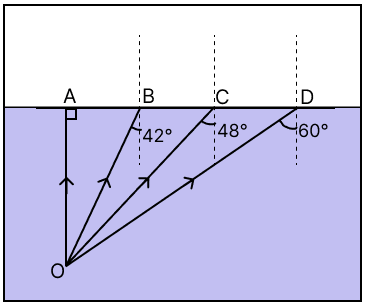
In the given diagram, two transparent optical media are shown. The rarer medium is air, while the denser medium is water. Redraw the diagram by showing the paths of the rays after striking the surface of separation AD for the incident rays OA, OB, OC and OD, respectively. (Critical angle for the denser medium = 48°)
In a hydraulic power station, water is first stored in a dam at a higher altitude.
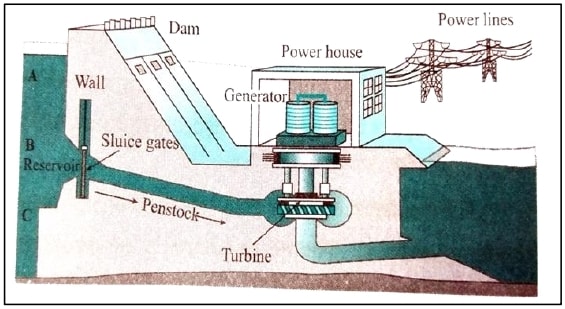
(a) What is the purpose of being stored at higher altitudes?
(b) When the water is allowed to fall on a turbine, what change of energy takes place for the water?
(c) Why is this turbine connected to the armature of a generator?
(d) Which basic law of physics is followed by the whole mechanism?