
History & Civics
The Guptas achieved remarkable advancements in art and culture. With reference to this, answer the following questions:
(a) What are the main characteristics of Gupta sculpture?
(b) How do the Ajanta paintings reflect the artistic excellence of the Gupta period?
(c) Compare the Bagh and Ajanta paintings in terms of style and themes.
Gupta Age
1 Like
Answer
(a) Gupta sculpture is known for its exquisite beauty and high skill. The art became distinctly Indian in character, moving away from foreign influences. The subjects depicted included scenes from the Buddha's life and Puranic mythology, treated with remarkable freshness. These sculptures show a sense of elegance and serenity, reflecting the cultural advancements of the Gupta period.
(b) The Ajanta paintings reflect the artistic excellence of the Gupta period through their superb execution and beautiful form and color. The paintings exhibit a deep insight into the human condition, with figures like Avalokiteshvara Padmapani embodying compassion and tenderness. The detailed composition, from the smallest elements like pearls and flowers to the overall scene, showcases the highest technical skill. The figures are set in a naturalistic environment, surrounded by celestial beings and animals, which adds to the realism and spiritual depth of the artwork, highlighting the artistic mastery of the time.
(c) The Ajanta paintings are known for their fine execution and detailed depictions of Buddhist themes, such as scenes from the Buddha's life. In comparison, Bagh paintings also depict religious themes but are simpler in style, focusing on scenes like a procession of elephants and a lovely scene of a dancer and woman musicians. The Ajanta paintings are more intricate and refined, while the Bagh paintings feature more bold and vivid depictions.
Answered By
2 Likes
Related Questions
Fa-Hien documented the social and economic conditions of India during the Gupta period. With reference to this, answer the following questions:
(a) Why is Fa-Hien's account considered a valuable source for understanding the Gupta period?
(b) How did his accounts highlight the religious and cultural tolerance of the time?
(c) What role did such foreign accounts play in reconstructing Indian history?
Read the lines given below and answer the question that follows:
"With fertile lands in eastern Uttar Pradesh and Bihar and abundant iron ore in Central India, the Gupta Empire thrived economically, fostering remarkable advancements in literature, art, architecture, science, and culture."
(a) Explain how the geographical advantages contributed to the economic prosperity of the Gupta Empire.
(b) Discuss the cultural and intellectual achievements during the Gupta period, highlighting why it is called the "golden age" of Indian history.
(c) How did the stable administration of the Gupta rulers influence trade and commerce?
Read the following excerpt and answer the questions that follows:
"A lengthy eulogy to Samudragupta (who ruled until c. 375) was inscribed on an Asokan pillar at Allahabad that provides detailed information about his military achievements and lists the names of the states and people conquered by him."
(Source: https://zh.unesco.org/si/kroad/sites/default/fi/es/know/edgebankarticle/vollll%20si/k%20roadthe%20gupta%20kingdom.pdf)
(a) Who was Harisena, and what does his work reveal about Samudragupta's conquests?
(b) Why is this inscription considered a critical source for understanding the Gupta Empire?
(c) Compare the importance of inscriptions with other sources, such as coins and foreign accounts, for studying ancient history.
With reference to the picture given below answer the following questions:
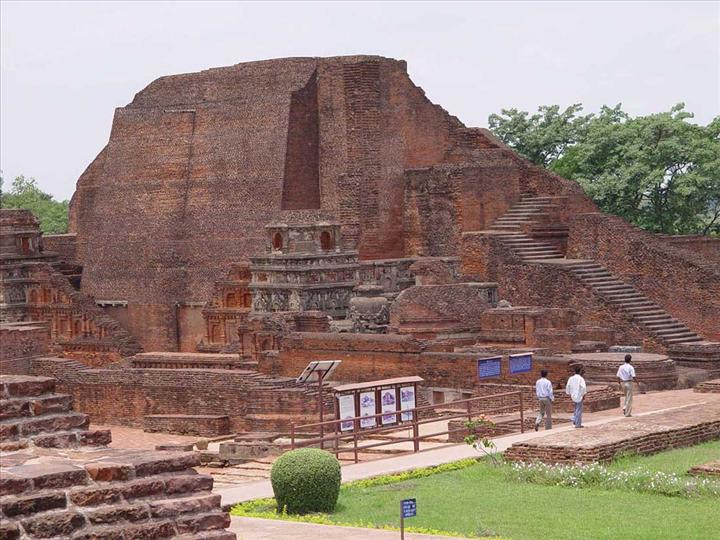
(a) Identify the monument shown in the image and describe its historical significance during the Gupta period.
(b) Name some of the foreign countries from which students came to study at Nalanda.
(c) What were the names of the three great libraries? Discuss the importance of these libraries in preserving and advancing knowledge during the Gupta period.