History & Civics
Answer
An important cause of the war was intense nationalism or "competitive patriotism".
- Germany had Kaiser Wilhelm II as her new Emperor.
- He went about proclaiming that "Germany was going to be the leader of the world."
- He wanted to establish a vast German Empire and gain important position in the international sphere.
- France and Germany were old rivals.
- After defeating France in the Franco-Prussian War (1870-71) Germany had seized the province of Alsace and most parts of Lorraine, which were rich in minerals and industrial products.
- The French dreamed of revenge and of taking back their lost provinces.
- The Italians desired to get back Trentino and the Port of Trieste which were inhabited by Italians but were still the part of Austria-Hungary.
- Then there was the "unsatisfied national spirit of the Balkan States—Serbia and Bulgaria, of Poland and of the people of Austria-Hungary."
- The political leaders were successful in fanning hatred and passion under the cover of nationalism.
Related Questions
The Triple Alliance formed in 1882 did not include :
- Germany
- Austria
- Italy
- France
Look at the newspaper excerpt given on the right and answer the questions that follow:
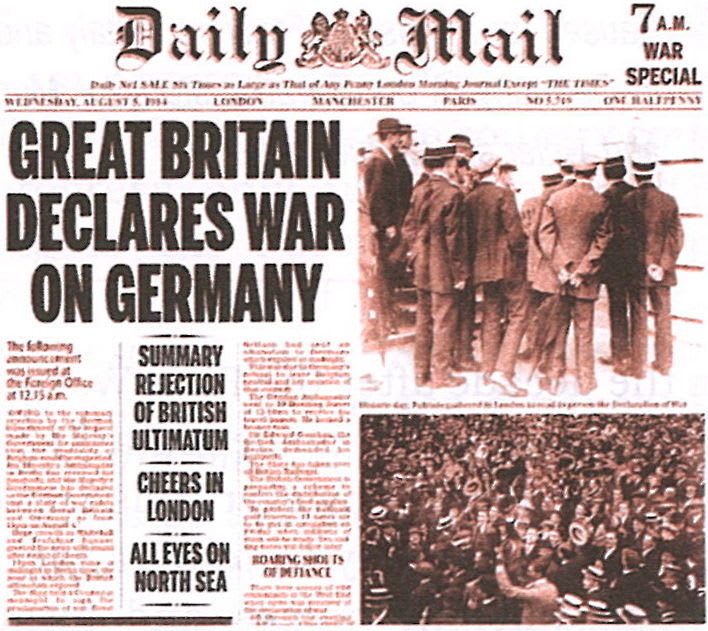
(a) Who summarily rejected British ultimatum? Why?
(b) Why did Great Britain declare war on Germany?
(c) What was the final outcome of the war that began after Great Britain declared war on Germany? How did it affect both the countries?
The newspaper goes on to state that:
"Archduke Franz Ferdinand, heir to the Austro-Hungarian throne, and his morganatic wife, the Duchess of Hohenberg, were assassinated today while driving through the streets of Sarajevo, the Bosnian capital. A youthful Servian student fired the shots, which added another to the long list of tragedies that have darkened the reign of Emperor Francis Joseph."
Which disaster was aggravated due to the above incident? What were the consequences of the disaster?
Why is the war between 1914 and 1918 called the First World War?