Physics
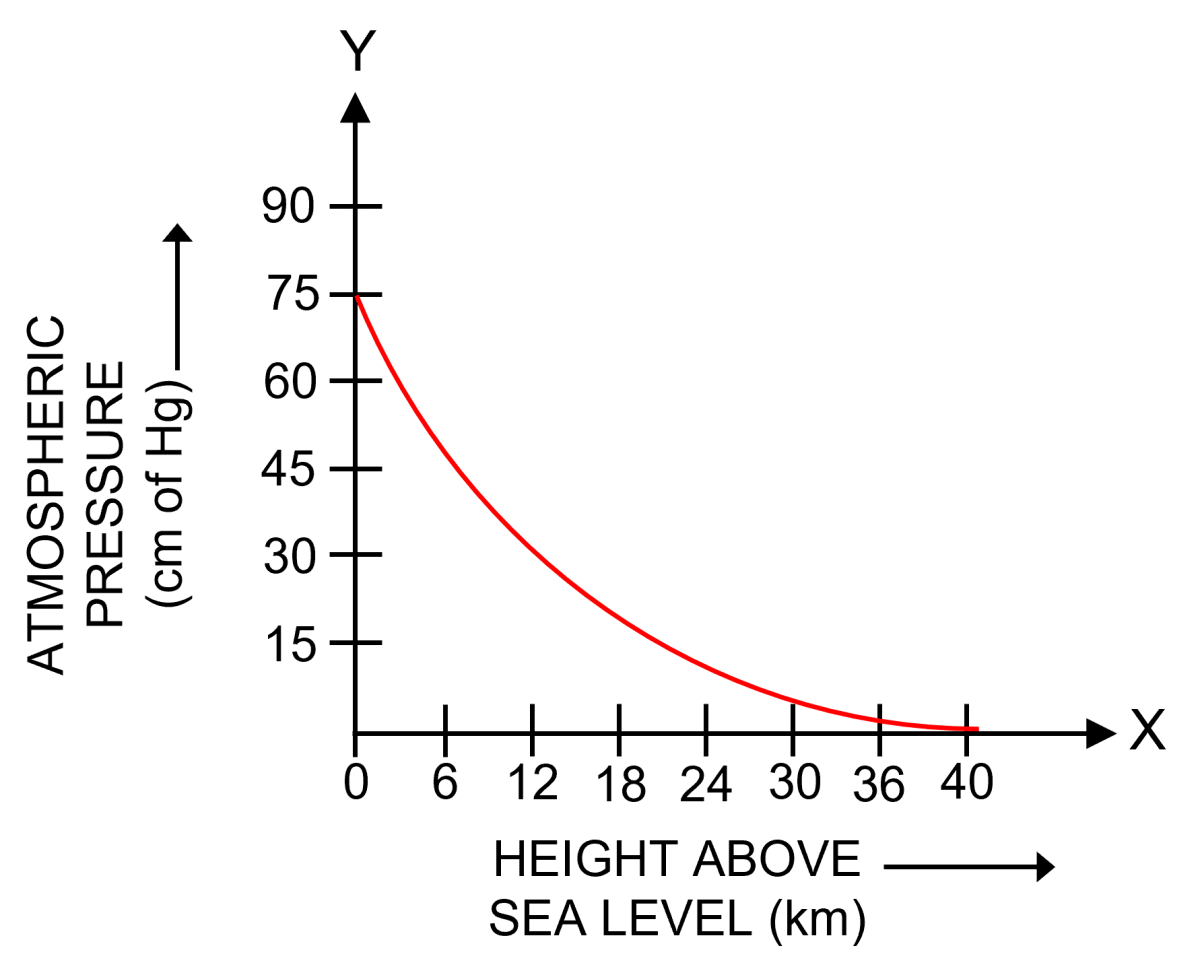
How does atmospheric pressure change with altitude ? Draw an approximate graph to show this variation.
Answer
The atmosphere consists of a number of parallel air layers. Each layer experiences a pressure on it due to the thrust or weight of the air column above it. Therefore, as we go up, the height of air column above us decreases and so thrust exerted by air column also decreases, which results in the decrease of atmospheric pressure with increases in altitude.
Since the lower air layers gets compressed due to the weight (or thrust) of the upper layers, therefore, the density of air layers is more near the earth's surface and it decreases as we go higher and higher.
The decrease in density with altitude is not linear. It is rapid at low altitude (near the sea level) and is slow at higher altitude. Due to decrease in density of air with altitude, the atmospheric pressure also decreases with altitude in a non linear way.
The figure below shows the variation of atmospheric pressure with height above the sea level.
Related Questions
Assertion (A) : A brick exerts maximum pressure on ground when it is placed with its longest side vertical.
Reason (R) : Larger the area on which a given thrust acts, lesser is the pressure exerted by it.
- both A and R are true and R is the correct explanation of A
- both A and R are true and R is not the correct explanation of A
- assertion is false but reason is true
- assertion is true but reason is false
Assertion (A) : The walls of a dam are made thicker at the bottom.
Reason (R) : Pressure is the same in all directions about a point inside the liquid.
- both A and R are true and R is the correct explanation of A
- both A and R are true and R is not the correct explanation of A
- assertion is false but reason is true
- assertion is true but reason is false
Assertion (A) : A hydraulic jack is used for squeezing oil out of linseed and cotton seeds.
Reason (R) : It works on the Pascal's principle.
- both A and R are true and R is the correct explanation of A
- both A and R are true and R is not the correct explanation of A
- assertion is false but reason is true
- assertion is true but reason is false
A hydraulic jack is used in a car workshop to lift a car. The jack consists of two connected pistons A(area = 5 cm2) and B(area = 250 cm2), filled completely with an incompressible hydraulic fluid (such as hydraulic oil). The fluid transmits pressure uniformly throughout the system. A force of 120 N is applied vertically downward on piston A.
Assuming the system to be ideal, answer the following questions:
(a) Calculate the pressure produced in the liquid by piston A.
(b) Determine the force exerted on piston B. Name the law used.
(c) Does this hydraulic jack provide a gain in force or a gain in distance? Justify your answer.
(d) If piston B rises by a height of 2 cm, calculate the distance moved by piston A.
(e) What would happen if a small air bubble enters the liquid of the hydraulic jack?