Chemistry
Identify the following reactions as either oxidation or reduction:
(i) O + 2e- ⟶ O2-
(ii) K - e- ⟶ K+
(iii) Fe3+ + e- ⟶ Fe2+
(iv) Zn ⟶ Zn2+ + 2e-
Related Questions
Select the correct statement(s) for the diagram shown below.
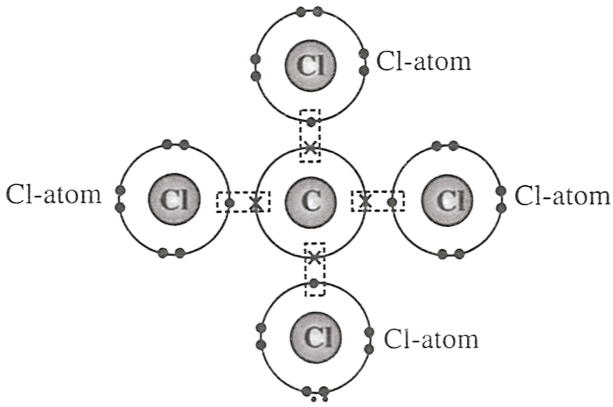
P — One atom of carbon transfers one electron to each chlorine atom.
Q — One atom of carbon shares four electron pairs, one with each of the four atoms of chlorine.
R — Carbon atom attains neon configuration and chlorine attains argon configuration after the combination.
- Only P
- Only Q
- Only R
- Both Q and R
Match the atomic numbers 4, 8, 10, 15 and 19 with each of the following:
(a) Element which can form trivalent ion.
(b) An element with 4 shells.
(c) Element with 6 valence electrons.
(d) Element which does not form an ion.
Give the terms for the following definitions:
(a) A bond formed by a shared pair of electrons, each bonding atom contributing one electron to the pair.
(b) A bond formed by transfer of electron(s).
Name or state the following.
(a) An element having valency zero.
(b) Metal with valency one.
(c) Atoms of the same element differing in mass numbers.
(d) Elements having same mass number but different atomic number.
(e) Bond formed by transfer of electrons(s)
(f) Ion formed by gain of electron(s)