History & Civics
Imagine you are Martin Luther, draft a speech that you would give to defend yourself at the Diet of Worms.
Answer
Honorable Emperor, Illustrious Princes, and Gracious Lords,
I stand before you today to answer for the books written and published under my name. You ask whether I am prepared to recant the teachings contained within them. To this, I must give a clear answer.
My writings are not all of one kind. In some, I have discussed simple faith and Christian charity—truths so plain that even my opponents agree they are useful. To revoke these would be to condemn the very truths of the Gospel. In other works, I have attacked the tyranny and false doctrines of the Papacy, which, through corrupt practices like the sale of Indulgences and Peter's Pence, have ravaged the Christian world and drained the wealth of the German nation. If I were to recant these, I would do nothing but strengthen this tyranny and open the floodgates to even greater impiety.
I confess that I have sometimes been more harsh in my tone than benefits a monk. I do not claim to be a saint. However, I am being judged for the substance of my doctrine, not the manners of my life.
Unless I am convinced by the testimony of the Holy Scriptures or by clear, evident reason, for I do not trust either the Pope or Councils alone, as they have often erred and contradicted themselves, I am bound by the scriptural texts I have quoted. My conscience is captive to the Word of God.
I cannot and will not recant anything, for to go against conscience is neither right nor safe.
Here I stand. I can do no other. God help me. Amen.
Related Questions
What was the role of the Council of Trent in Counter Reformation?
With reference to the Reformation Movement, answer the following:
(a) Mention any three Church practices that caused dissatisfaction among the people?
(b) How did New Learning become a factor that led to the Reformation?
(c) Who were the Protestants? By what other names was Protestantism known?
Study the picture given below and answer the following questions.
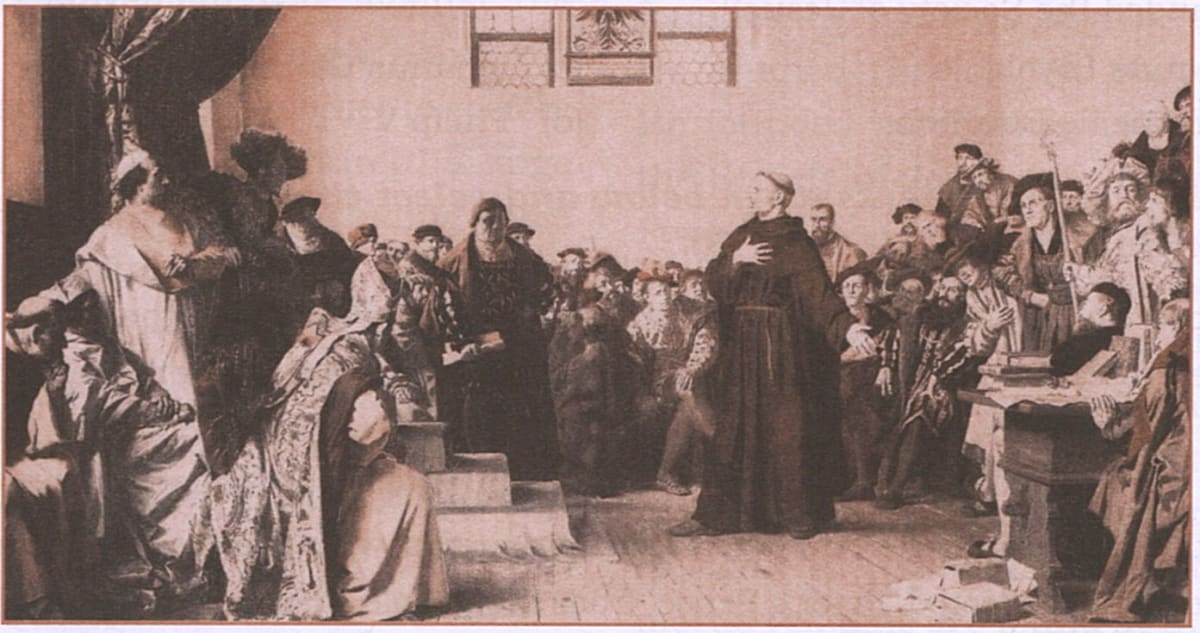
(a) Identify the incident in the picture. Where was it held?
(b) Name the person who was there to defend his case. What was the final outcome of the case?
(c) State the contribution of this person in reforming the church in Europe
The period when religious reformers challenged some of the practices of the Roman Catholic Church across Europe in the 15th and 16th centuries, was marked by the rise of Bhakti and Sufi movements in India. Compare and contrast the religious reform movements in India and Europe.