History & Civics
This is an impression of the greatest Mauryan emperor's rock inscription at Girnar.
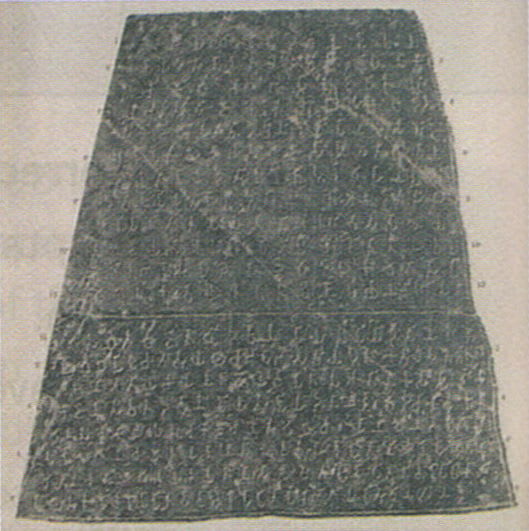
(a) Which emperor ordered the inscription to be engraved?
(b) What kind of information is obtained from such inscriptions?
Answer
(a) Emperor Ashoka ordered the inscription to be engraved.
(b) These inscriptions are called Ashokan edicts. From these inscriptions, we obtain important information like:
- Ashoka's Dhamma (moral code) and how he wanted his people to live.
- His policies of governance, such as kindness to animals, tolerance of all religions, and non-violence.
- His efforts to spread Buddhism and maintain peace and welfare across his empire.
- These inscriptions are crucial sources for understanding Mauryan administration, philosophy, and society.
Related Questions
What was the system of Mauryan administration?
State some examples of the Mauryan architecture.
The word dhamma is derived from the Sanskrit word dharma, which means religious and moral duty. In this context, answer the following questions:
- What was Ashoka's dhamma? State its salient features.
- How did Ashoka spread the principles of dhamma within and outside India?
- What are edicts? Why are Ashokan edicts important?
- Mention some of the steps taken by Ashoka for the welfare of his people.
Number the following statements to put them in the correct chronological order.
- Brihadratha was killed by his commander-in-chief, Pushyamitra Sunga.
- Chanakya trained young Chandragupta, and together they planned the conquest of the Nanda kingdom.
- The Kalinga War was a turning point in Ashoka's life.
- Bindusara extended the Mauryan Empire southwards, as far as Karnataka.