
History & Civics
The word dhamma is derived from the Sanskrit word dharma, which means religious and moral duty. In this context, answer the following questions:
- What was Ashoka's dhamma? State its salient features.
- How did Ashoka spread the principles of dhamma within and outside India?
- What are edicts? Why are Ashokan edicts important?
- Mention some of the steps taken by Ashoka for the welfare of his people.
Mauryan Empire
4 Likes
Answer
The word dhamma is derived from the Sanskrit word dharma, which means religious and moral duty. Ashoka defined the main principles of dhamma as follows:
- Non-violence or ahimsa: He urged his subjects to practise non-violence towards all living beings.
- Acceptance of all sects: He advocated a policy of tolerance towards all religions.
- Obedience to parents and elders: He advised that elders were to be respected, and children treated with understanding.
- Generosity towards all: He encouraged charity towards all.
Ashoka spread the principles of dhamma within and outside India in the following ways:
- Emperor Ashoka strictly followed the principles of dhamma which inspired others to do the same. He treated his people as his children.
- He built and supported stupas, viharas, and chaityas for Buddhist monks.
- He sent Buddhist scholars, including his son Mahendra and daughter Sanghamitra, to spread dhamma abroad, especially to Sri Lanka.
- He set up edicts across the empire promoting Buddhist values like dhamma, ahimsa, and moral conduct.
Edicts are official/royal proclamations or commands. Ashoka had them engraved on rocks, polished stone pillars, and caves across his empire. Written mostly in Prakrit and Brahmi script, they also appeared in Greek, Kharoshti, and Aramaic in the northwest. Ashokan edicts are important as they promoted the Buddhist moral code, encouraged dhamma and ahimsa, and serve as key sources of information about the Mauryan Empire.
Some of the facilities built by Ashoka for the welfare of his people are as follows:
- Wide roads with shady trees on both sides.
- Rest houses and wells along the roads for travellers.
- Hospitals for the care of people and animals.
- Waterways and canals for irrigation and transport.
Answered By
2 Likes
Related Questions
What was the system of Mauryan administration?
State some examples of the Mauryan architecture.
This is an impression of the greatest Mauryan emperor's rock inscription at Girnar.
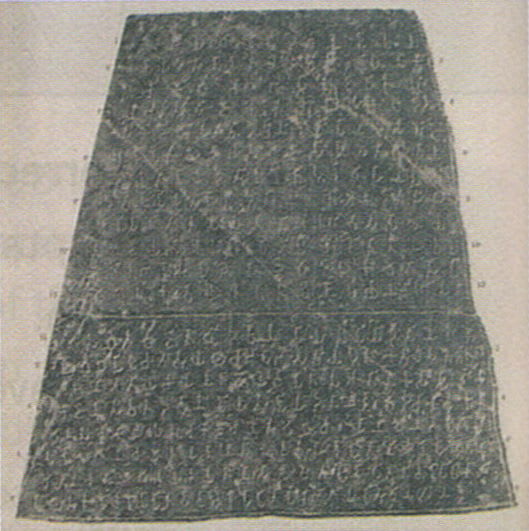
(a) Which emperor ordered the inscription to be engraved?
(b) What kind of information is obtained from such inscriptions?Number the following statements to put them in the correct chronological order.
- Brihadratha was killed by his commander-in-chief, Pushyamitra Sunga.
- Chanakya trained young Chandragupta, and together they planned the conquest of the Nanda kingdom.
- The Kalinga War was a turning point in Ashoka's life.
- Bindusara extended the Mauryan Empire southwards, as far as Karnataka.