
Mathematics
In parallelogram ABCD, ∠A = 3 times ∠B. Find all the angles of the parallelogram. In the same parallelogram, if AB = 5x - 7 and CD = 3x + 1, find the length of CD.
Quadrilaterals
18 Likes
Answer
It is given that in parallelogram ABCD, ∠A = 3 times ∠B.
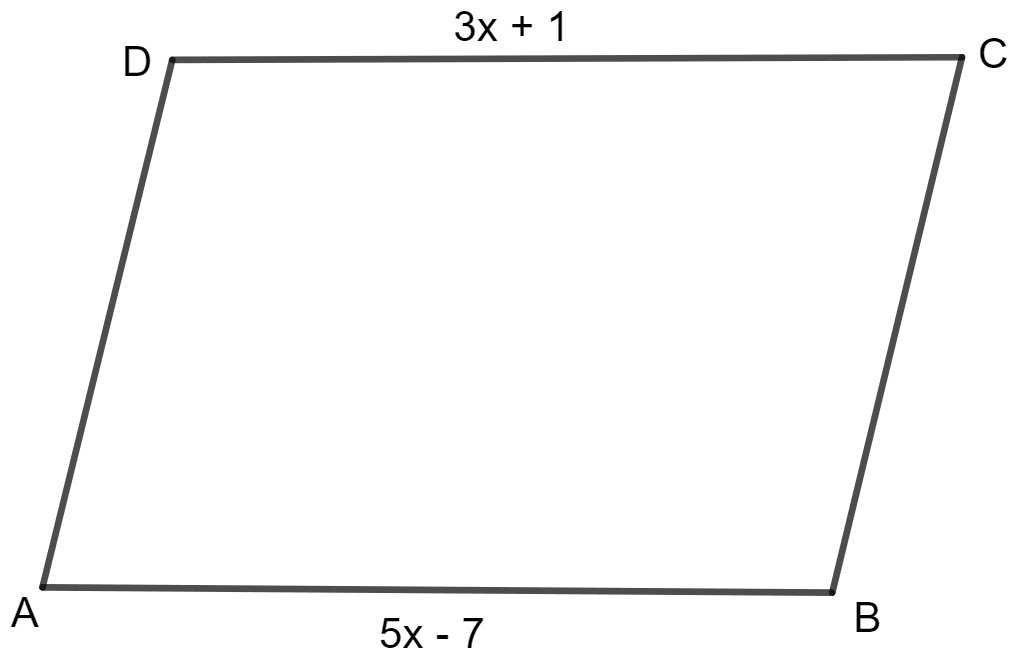
Let ∠B be a.
Then, ∠A = 3a.
As we know, the consecutive angles of a parallelogram are supplementary.
⇒ ∠A + ∠B = 180°
⇒ 3a + a = 180°
⇒ 4a = 180°
⇒ a =
⇒ a = 45°
Thus, ∠B = ∠D = a = 45°.
And, ∠A = ∠C = 3a = 3 45° = 135°
It is also given that AB = 5x - 7 and CD = 3x + 1.
AB = CD (opposite sides of parallelogram are equal)
⇒ (5x - 7) = (3x + 1)
⇒ 5x - 7 = 3x + 1
⇒ 5x - 3x = 7 + 1
⇒ 2x = 8
⇒ x =
⇒ x = 4
CD = 3x + 1
= 3 4 + 1
= 12 + 1
= 13
Hence, ∠A = 135°, ∠C = 135°, ∠B = 45°, ∠D = 45° and CD = 13 units.
Answered By
11 Likes
Related Questions
The diagonals of a quadrilateral are equal and bisect each other. The quadrilateral is a :
square
rhombus
parallelogram
rectangle
A quadrilateral will be a square, if its:
each angle is 90°
each angle is 90° and the diagonals are equal
all the sides are equal
all the sides are equal and each angle is 90°
In parallelogram PQRS, ∠Q = (4x - 5)° and ∠S = (3x + 10)°. Calculate: ∠Q and ∠R.
In rhombus ABCD :
(i) if ∠A = 74°, find ∠B and ∠C.
(ii) if AD = 7.5 cm, find BC and CD.