
Mathematics
In the adjoining figure, PA and PB are tangents from point P to a circle with centre O. If the radius of the circle is 5 cm and PA ⊥ PB, then the length OP is equal to
5 cm
10 cm
7.5 cm
5√2 cm

Circles
17 Likes
Answer
Join OA as shown in the figure below:

OA ⊥ PA (∵ radius of a circle and tangent through that point are perpendicular to each other.)
∴ ∠OAP = 90°.
Given, PA ⊥ PB
∴ ∠APB = 90°.
∵ the tangents are equally inclined to the line joining the point and the centre of the circle.
∠APO = x ∠APB = 45°.
Since, sum of angles in a triangle = 180°.
In △OAP,
⇒ ∠APO + ∠OAP + ∠AOP = 180°
⇒ 45° + 90° + ∠AOP = 180°
⇒ 135° + ∠AOP = 180°
⇒ ∠AOP = 180° - 135°
⇒ ∠AOP = 45°.
Since, ∠AOP = ∠APO hence, △OAP is an isosceles triangle with OA = AP = 5 cm.
In right angled triangle △OAP,
Hence, Option 4 is the correct option.
Answered By
10 Likes
Related Questions
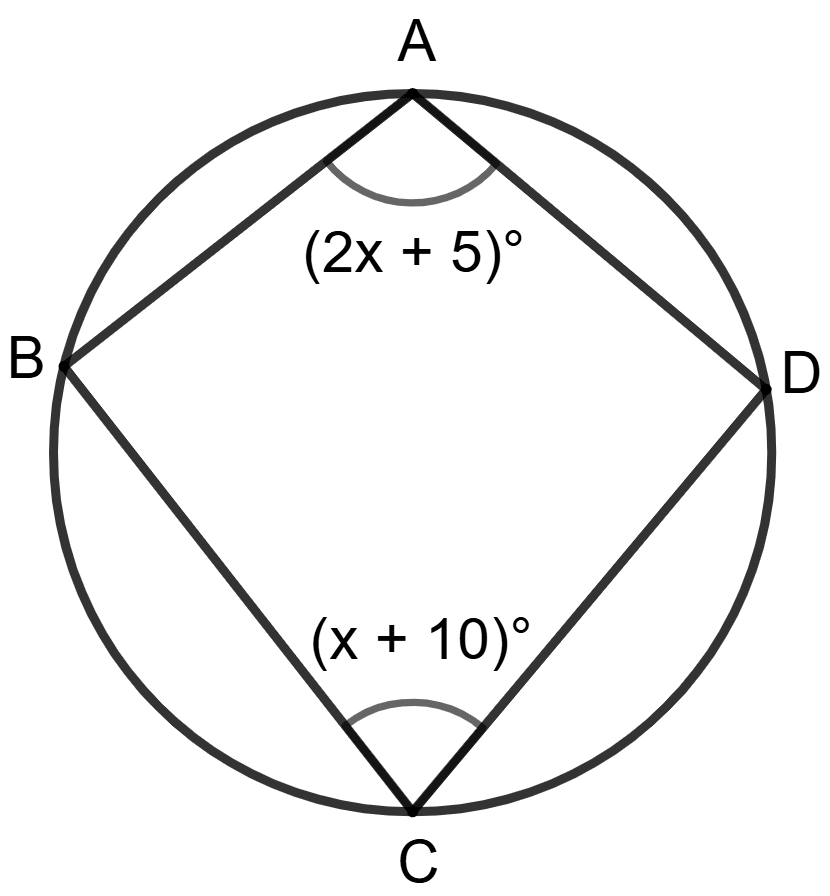
In the adjoining figure, ABCD is a cyclic quadrilateral. If ∠BAD = (2x + 5)° and ∠BCD = (x + 10)°, then x is equal to
65
45
55
50
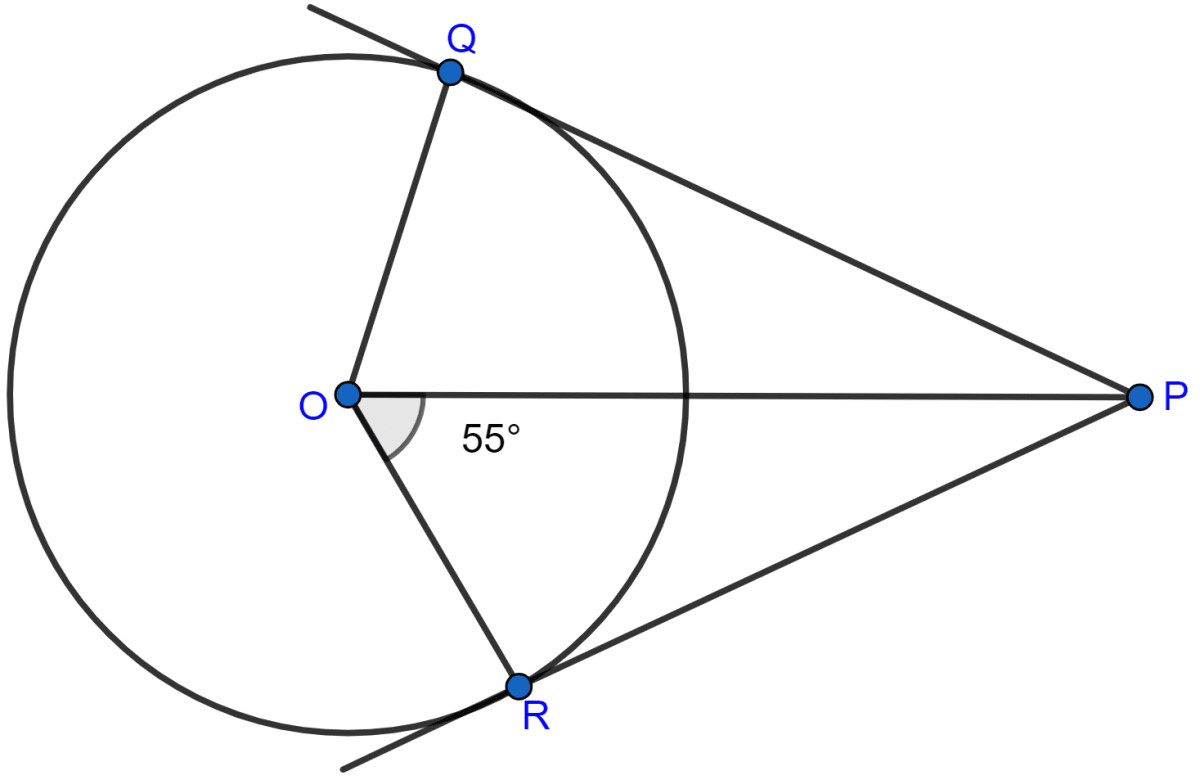
In the adjoining figure, PQ and PR are tangents from P to a circle with centre O. If ∠POR = 55°, then ∠QPR is
35°
55°
70°
80°
At one end A of a diameter AB of a circle of radius 5 cm, tangent XAY is drawn to the circle. The length of the chord CD parallel to XY and at a distance 8 cm from A is
4 cm
5 cm
6 cm
8 cm
If radii of two concentric circles are 4 cm and 5 cm, then the length of each chord of one circle which is tangent to the other is
3 cm
6 cm
9 cm
1 cm