Mathematics
In the given figure (not drawn to scale), BC is parallel to EF, CD is parallel to FG, AE : EB = 2 : 3, ∠BAD = 70°, ∠ACB = 105°, ∠ADC = 40° and AC is bisector of ∠BAD.
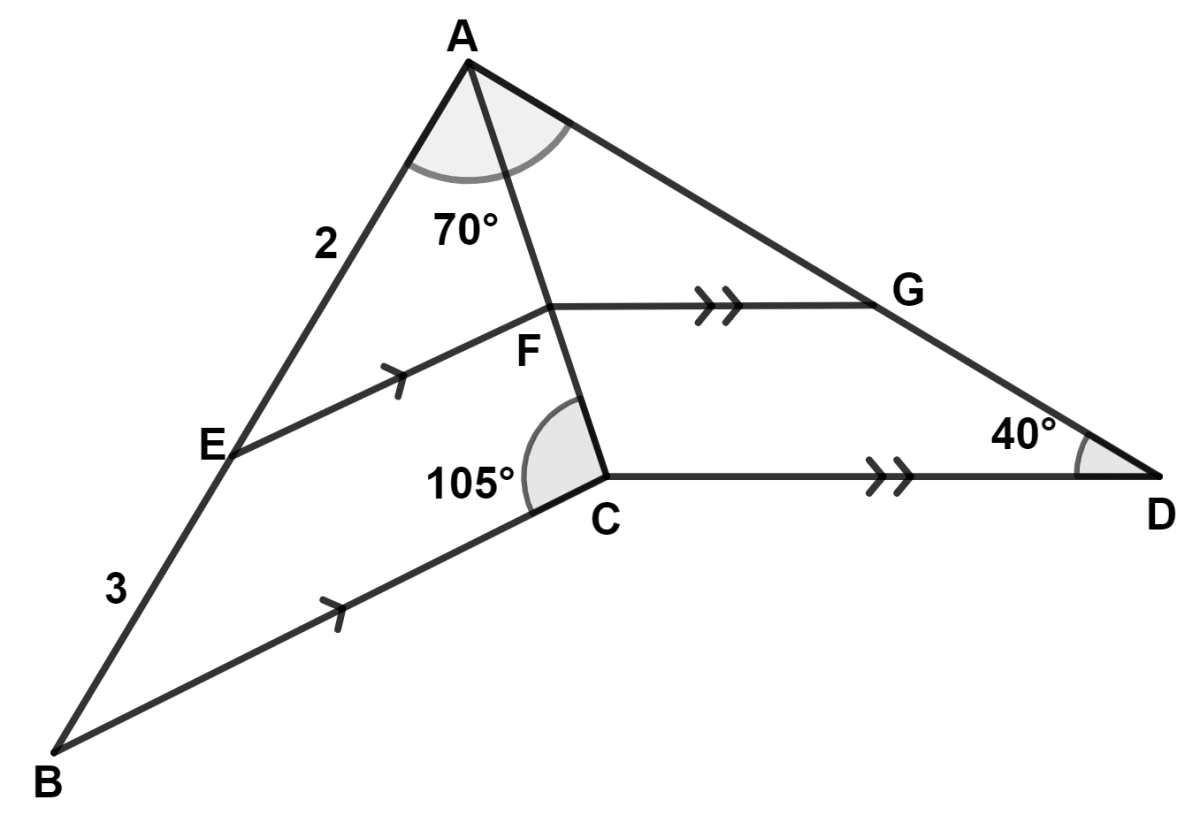
(a) Prove Δ AEF ~ Δ AGF
(b) Find :
(i) AG : AD
(ii) area of Δ ACB: area Δ ACD
(iii) area of quadrilateral ABCD: area of Δ ACB.
Related Questions
If a polynomial x3 + 2x2 – ax + b leaves a remainder -6 when divided by x + 1 and the same polynomial has x - 2 as a factor, then find the values of a and b.
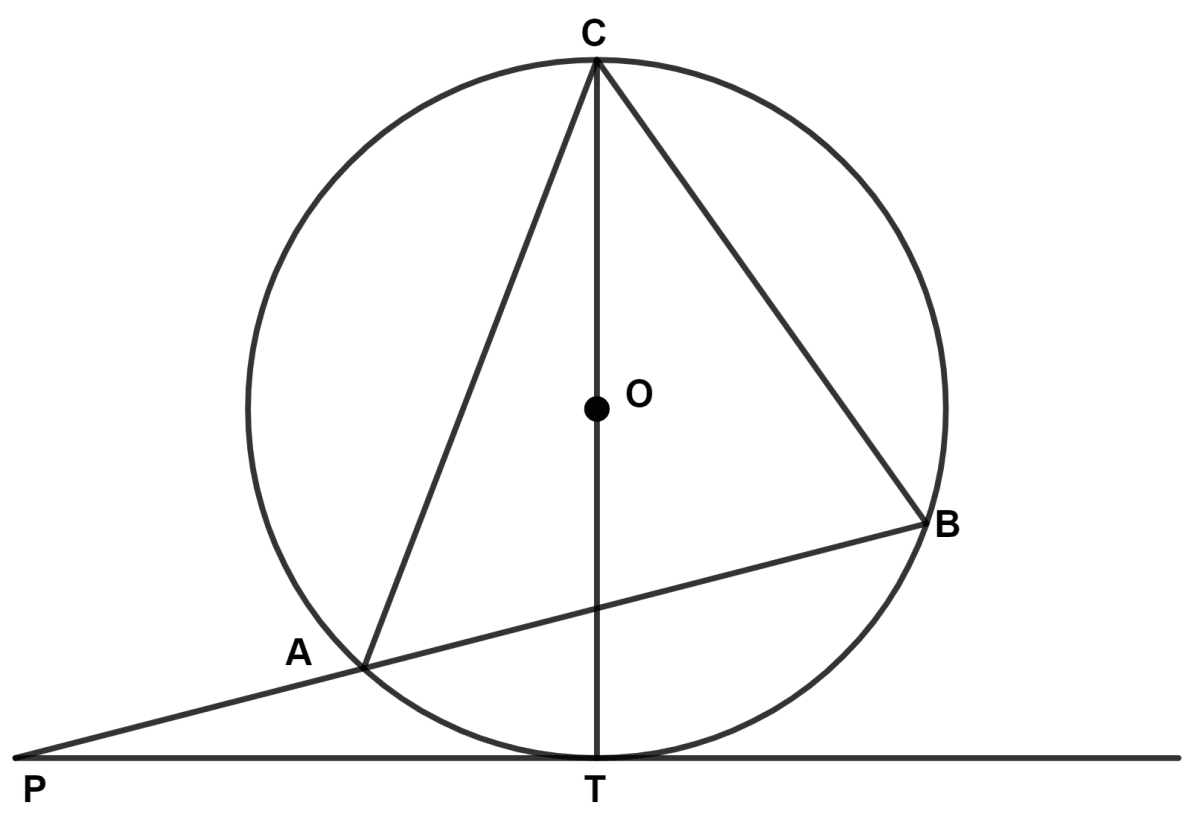
In the given figure, angle ABC = 70° and angle ACB = 50°. Given, O is the centre of the circle and PT is the tangent to the circle. Then calculate the following angles
(a) ∠CBT
(b) ∠BAT
(c) ∠PBT
(d) ∠APT
(a) Construct a triangle ABC such that BC = 8 cm, AC = 10 cm and ∠ABC = 90°.
(b) Construct an incircle to this triangle. Mark the centre as I.
(c) Measure and write the length of the in-radius.
(d) Measure and write the length of the tangents from vertex C to the incircle.
(e) Mark points P, Q and R where the incircle touches the sides AB, BC, and AC of the triangle respectively. Write the relationship between ∠RIQ and ∠QCR.
(Use a ruler and a compass for this question.)