
Mathematics
In triangle ABC, D and E are mid-points of the sides AB and AC respectively. Through E, a straight line is drawn parallel to AB to meet BC at F. Prove that BDEF is a parallelogram. If AB = 8 cm and BC = 9 cm; find the perimeter of the parallelogram BDEF.
Mid-point Theorem
2 Likes
Answer
By mid-point theorem,
The line segment joining the mid-points of any two sides of a triangle is parallel to the third side and is equal to half of it.
By converse of mid-point theorem,
The straight line drawn through the mid-point of one side of a triangle parallel to another, bisects the third side.
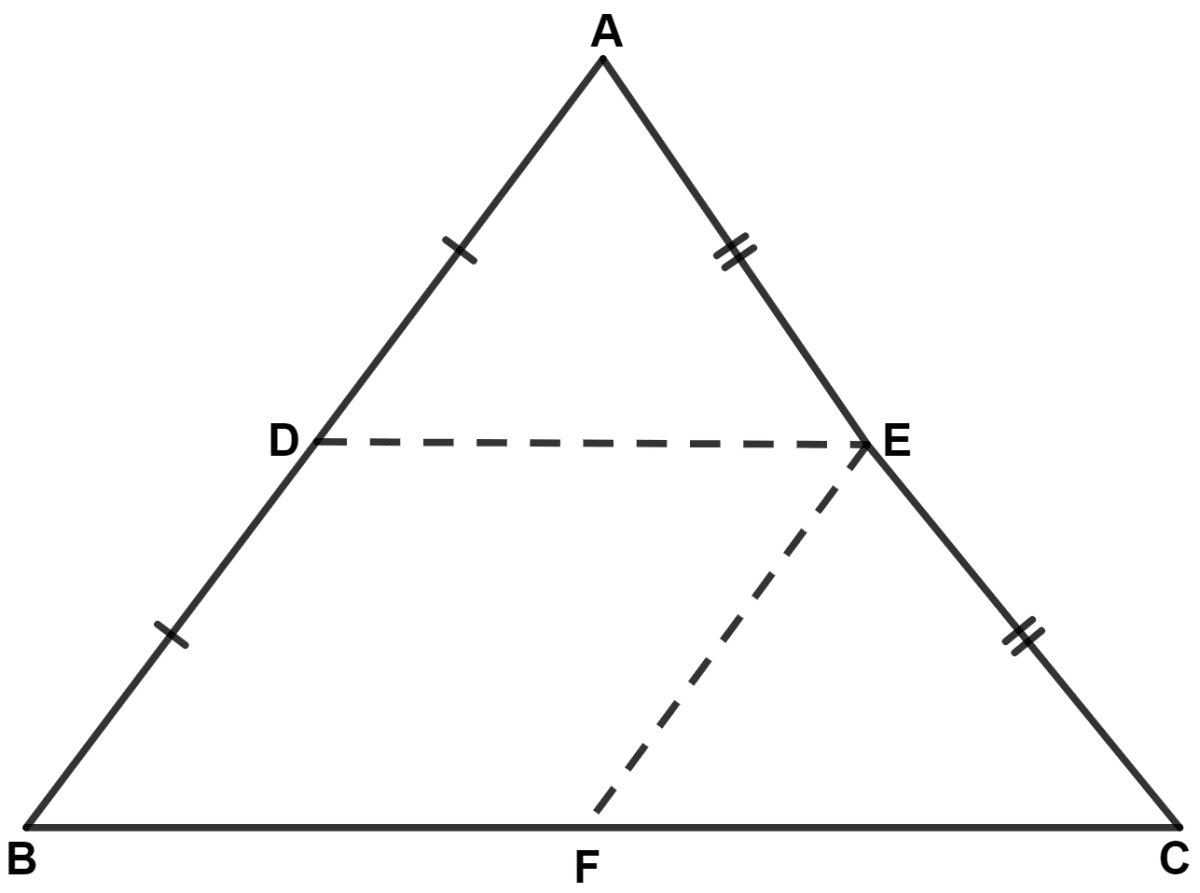
Given,
E is mid-point of AC and EF || AB.
∴ F is mid-point of BC (By converse of mid-point theorem).
Since, D and E are mid-points of sides AB and AC respectively.
∴ DE || BC and DE = (By mid-point theorem)
⇒ DE || BF and DE = BF (As F is mid-point of BC).
Given,
EF || AB
∴ EF || BD.
Since, E and F are mid-points of sides AC and BC respectively.
∴ EF = = BD. (By mid-point theorem)
Since, opposite sides of quadrilateral BDEF are parallel and equal.
∴ BDEF is a parallelogram.
From figure,
⇒ BD = = 4 cm,
⇒ BF = = 4.5 cm.
Perimeter of BDEF = BD + DE + EF + BF
= BD + BF + BD + BF (Since opposite sides of parallelogram are equal)
= 4 + 4.5 + 4 + 4.5
= 17 cm.
Hence, perimeter of parallelogram BDEF = 17 cm.
Answered By
1 Like
Related Questions
Assertion (A): The figure formed by joining the mid-points of the sides of a quadrilateral ABCD is a square.
Reason (R): Diagonals of quadrilateral ABCD are not equal and are not perpendicular to each other.
A is true, but R is false.
A is false, but R is true.
Both A and R are true, and R is the correct reason for A.
Both A and R are true, and R is the incorrect reason for A.
Assertion (A): R, S, D and E are mid-points of OC, OB, AB and AC respectively, then DERS is a parallelogram.
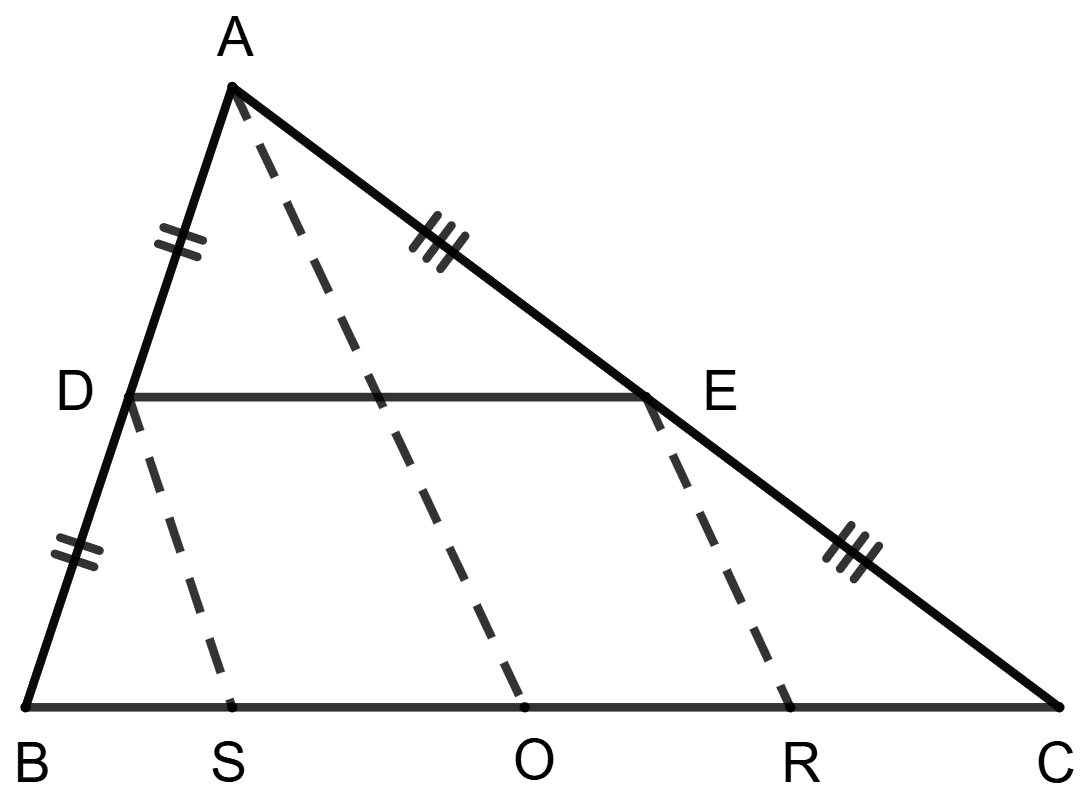
Reason (R): DS ∥ AO ∥ ER and DS = ER = .
A is true, but R is false.
A is false, but R is true.
Both A and R are true, and R is the correct reason for A.
Both A and R are true, and R is the incorrect reason for A.
P, Q and R are mid-points of sides AB, BC and CD respectively of a rhombus ABCD. Show that PQ is perpendicular to QR.
The diagonals of a quadrilateral ABCD are perpendicular to each other. Prove that the quadrilateral obtained by joining the mid-points of its adjacent sides is a rectangle.