
Mathematics
In triangle ABC, D and E are points on side AB such that AD = DE = EB. Through D and E, lines are drawn parallel to BC which meet side AC at points F and G respectively. Through F and G, lines are drawn parallel to AB which meet side BC at points M and N respectively. Prove that :
BM = MN = NC.
Mid-point Theorem
20 Likes
Answer
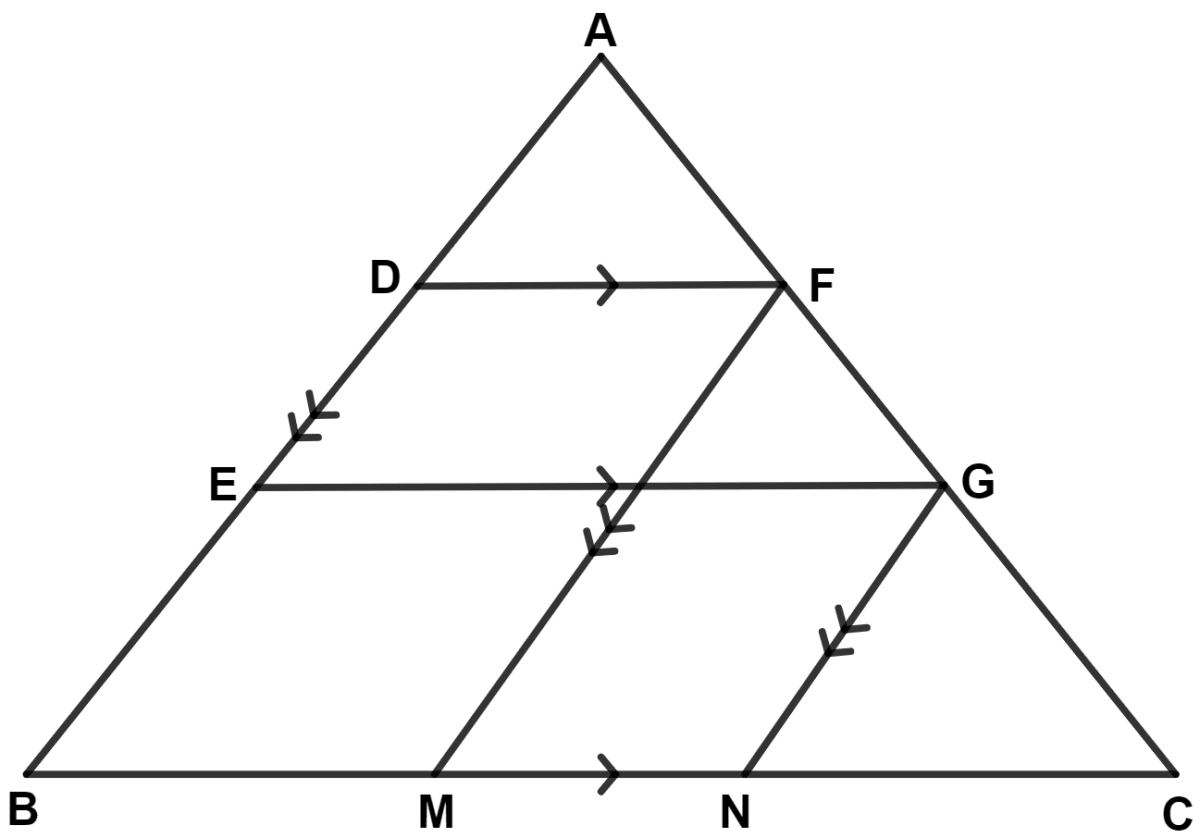
By mid-point theorem,
The line segment joining the mid-points of any two sides of a triangle is parallel to the third side and is equal to half of it.
By converse of mid-point theorem,
The straight line drawn through the mid-point of one side of a triangle parallel to another, bisects the third side.
By equal intercept theorem,
If a transversal makes equal intercepts on three or more parallel lines, then any other line cutting them will also make equal intercepts.
In △ AEG,
D is the mid-point of AE and DF || EG.
∴ F is mid-point of AG (By converse of mid-point theorem)
∴ AF = FG ………(1)
Since,
DF || EG || BC and DE || BE
∴ FG = GC [By equal intercept theorem]………..(2)
From equation (1) and (2), we get :
⇒ AF = FG = GC
Since, AB || FM || GN and AF = FG = GC
∴ BM = MN = NC [By equal intercept theorem]
Hence, proved that BM = MN = NC.
Answered By
11 Likes
Related Questions
In triangle ABC, angle B is obtuse. D and E are mid-points of sides AB and BC respectively and F is a point on side AC such that EF is parallel to AB. Show that BEFD is a parallelogram.
In parallelogram ABCD, E and F are mid-points of the sides AB and CD respectively. The line segments AF and BF meet the line segments ED and EC at points G and H respectively. Prove that :
(i) triangles HEB and FHC are congruent;
(ii) GEHF is a parallelogram.
In triangle ABC; M is the mid-point of AB, N is mid-point of AC and D is any point in base BC. Use intercept theorem to show that MN bisects AD.
If the quadrilateral formed by joining the mid-points of the adjacent sides of quadrilateral ABCD is a rectangle, show that the diagonals AC and BD intersect at right angle.