
History & Civics
The Indian National Army (INA) has immortalised the name of Netaji Subhas Chandra Bose. In this context, briefly describe :
(a) Formation of the Indian National Army.
(b) Its effects to liberate India from foreign rule.
Forward Bloc & INA
16 Likes
Answer
(a) The Azad Hind Fauj (the Indian National Army or INA) was establiched by S.C. Bose in Singapore for the freedom of his country. It was helped by Rash Behari Bose, an old revolutionary. He had already organised the Indian Independence League to attain the complete and immediate independence of India. Likewise, the Indian National Army had already been formally established in September 1942 with Mohan Singh acting as its first Commander-in-Chief. After taking the charge Subhas Chandra Bose became the President of the Indian Independence League as well as the Supreme Commander of the Indian National Army. The INA was joined in large numbers by the Indians living in South East Asia and by the Indian soldiers and officers captured by the Japanese forces in Burma, Malaya and Singapore. He set up Recruitment and Training Departments as well. Training Camps were opened for men and women.
(b) The Subhas brigade captured Peletwa, Daletme and Mowdok and entered the frontiers of India. Later on the INA captured the strong military post of Klang Klang. The Subhas Brigade gave a tough fight to the British forces in the Assam Hills and succeeded in capturing Ukhral and Kohima. The main objective of the INA was to capture Imphal, the capital city of Manipur. Gandhi and Azad Brigades advanced within two miles of Imphal. However, the Japanese had to withdraw their forces because of their entanglement with the Americans in the Pacific Ocean, and the rainy season set in earlier. Hence, the fighters of the Indian freedom were also overpowered by the British army.
Answered By
2 Likes
Related Questions
With reference to the Cripps Mission, explain :
(a) Why was the Cripps Mission sent to India?
(b) Mention four causes of their proposals.
(c) Why did both Congress and Muslim League reject it?
The All India Congress Committee which met at Bombay on 8th August, 1942 passed the famous Quit India Resolution.
In this context, answer the following questions :
(a) Mention the reasons that led to the passing of the Resolution.
(b) Explain the spread of the Quit India Movement.
(c) State the repressive measures practised by the British Government.
(d) State the importance of the Movement.
Netaji Subhas Chandra Bose played a great part in the National Movement. In this context, explain the following :
(a) Political aims of Netaji.
(b) Part played by him in liberating India from the British yoke.
Study the picture given and answer the following questions:
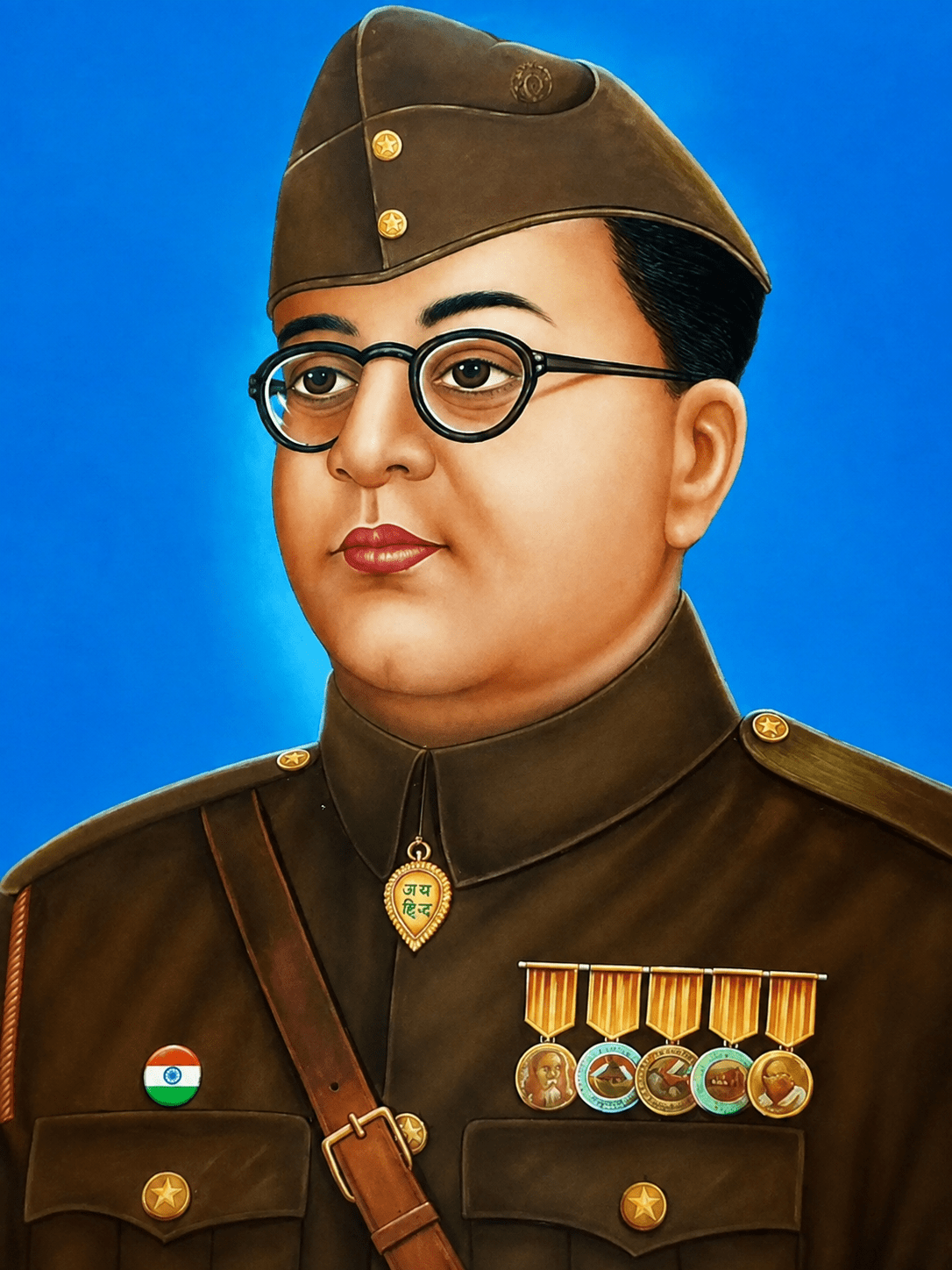
(a) Identify the leader given in the picture. Name the Political party and the Military Organisation that he formed.
(b) State any three objectives of the Political party that he founded.
(c) Mention any four objectives of the Military Organisation that he formed.