History & Civics
The Indian National Movement is divided into three phases. With reference to the Second Phase of the Indian National Movement, answer the following questions:
(i) Who partitioned Bengal? Mention any two points to explain the perspective of the Nationalists regarding the actual motive behind the decision of Partition.
(ii) What was the objective of the Assertive Nationalists? Mention any two contributions of Bal Gangadhar Tilak.
(iii) In which year was the Muslim League formed? Mention any three objectives of the Muslim League.
Answer
(i) Lord Curzon, the Viceroy of India was responsible for the Partition of Bengal in 1905. The actual motives behind the partition from the perspective of the Nationalists were:
- The Partition of the state was intended to curb Bengali influence by not only placing Bengalis under two administrations but by reducing them to a minority in Bengal itself.
- The Partition was meant to foster division on the basis of religion. East Bengal would be predominantly a Muslim majority state and West Bengal would have a Hindu majority.
(ii) The main objective of the Assertive Nationalists was the immediate attainment of complete independence or 'Swaraj'. Two contributions of Bal Gangadhar Tilak are:
- Demand for Swaraj: Tilak was the first to openly declare the demand for Swaraj. "Swaraj is my birth right," he said, "and I shall have iť".
- Established Home Rule League: Tilak set up a Home Rule League at Pune in 1916 to attain home rule or a dominion status for India under the British Empire along the lines of countries like Canada and Australia.
(iii) Muslim League was formed in 1906.
Objectives of the Muslim League —
- To promote, among the Muslims of India, support for the British government and to remove any misconceptions regarding the intention of the government in relation to Indian Muslims.
- To protect and advance the political rights and interests of the Muslims and to represent their needs and aspirations to the government in mild and moderate language.
- To prevent the rise of feelings of hostility between the Muslims of India and other communities.
Related Questions
The judiciary is the system of courts that interprets and guards the Indian Constitution. With reference to the Supreme Court of India, answer the following:
(i) What is the composition of the Supreme Court? Why is it called the Court of Record?
(ii) Explain the power of Judicial Review.
(iii) What is meant by the term Original Jurisdiction? Mention any three cases which come under this jurisdiction.
The Revolt of 1857 was the beginning of the independence struggle against the colonial rule of the British. With reference to the consequences of the Revolt, answer the following:
(i) Mention any three changes made in the administration with the end of the Company's Rule.
(ii) State any three policies promised to Indians in Queen Victoria's Proclamation.
(iii) Mention any four changes made in the army after the Revolt.
Look at the picture given and answer the following questions:
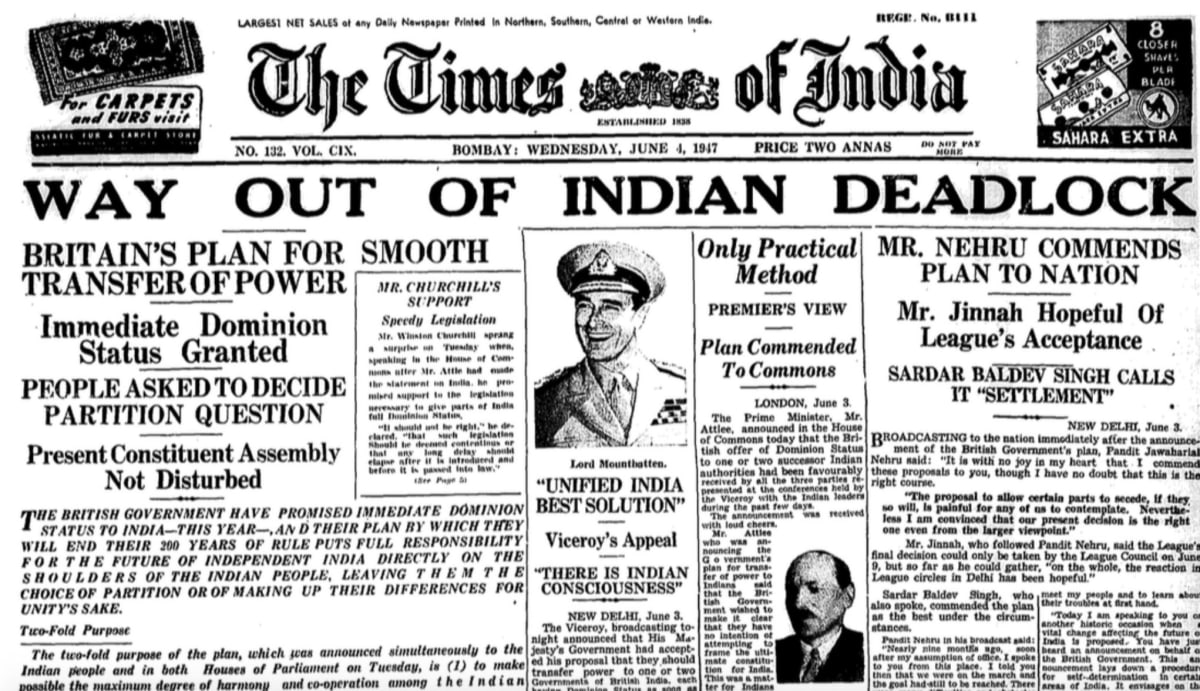
(i) Name the Viceroy who announced the plan for smooth transfer of power. Mention any two clauses of his plan with reference to the Princely States.
(ii) Mention any three reasons for the acceptance of his plan by the Congress.
(iii) Mention any four provisions of the Indian Independence Act of 1947.
The final act of the long-drawn-out negotiations took place at Versailles on Saturday afternoon, and to-day Germany and the Allies - always with the exception of America - are at peace. Peace is a blessed word, and both the word and the fact are welcome to-day. So far as Germany is concerned there is for the present an end of strife, and at least a formal return to the decent relations of civilised states.
Editorial: Peace in force (12 January 1920)
The Guardian
(a) Mention any three causes of the World War which ended with the signing of the treaty being discussed in the passage above.
(b) Name the organisation which was established in 1920 to maintain peace after this war. Mention any two of its objectives.
(c) Mention any four clauses of the Treaty which affected Germany.