
Biology
John, Sandeep and Shubham, three class 6 students, were discussing their school garden project. They had collected leaves of Banyan, Rose and Sitk cotton for a herbarium. While comparing them, they noticed that the Banyan leaf looked quite different from the other two. Shubham, who was confident about leaf types, explained that Banyan has a simple leaf, whereas Rose and Silk cotton have compound leaves. Answer the following questions:
(i) What is the main difference between a simple leaf and a compound leaf?
(ii) How do the leaves of Rose and Silk cotton differ from each other even though both are compound leaves?
(iii) Segregate the following leaves as simple and compound: Neem, Peepal, Guava, Mango, Gulmohar and Banana.
(iv) What is the difference between 'petiole' and 'midrib' ?
Leaf
3 Likes
Answer
(i) A simple leaf has a single, undivided leaf blade (lamina) whereas a compound leaf has the leaf blade divided into many smaller parts called leaflets.
(ii) Rose leaf is a compound leaf with incision upto midrib whereas Silk cotton leaf is a compound leaf with with incision upto petiole.
(iii) Peepal, Guava, Mango, Banana are simple leaves.
Neem and Gulmohar are compound leaves.
(iv) The basal part of a leaf is a stalk called petiole. Petiole continues into a lamina as midrib.
Answered By
3 Likes
Related Questions
The figures given below show three insectivorous plants. Study the same and answer the following questions :
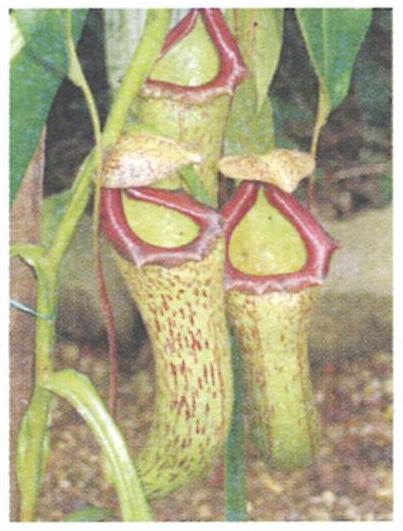
A
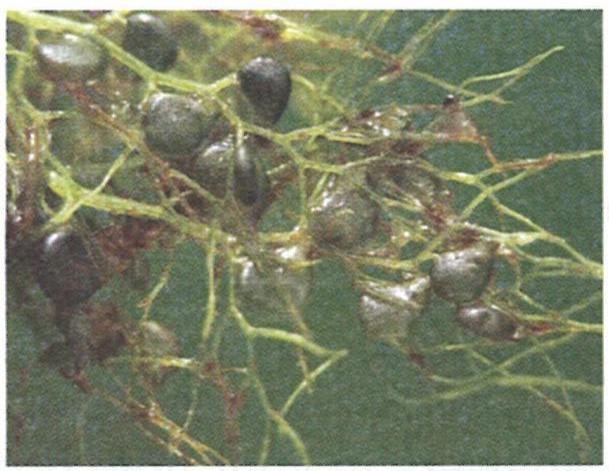
B
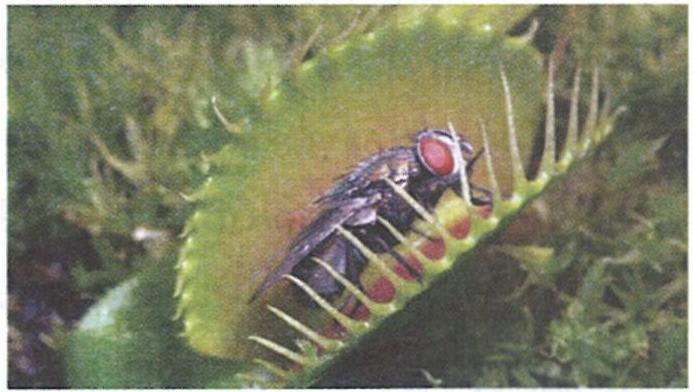
C
(i) Name the plants shown as A, B and C.
(ii) For which specific nutritional element do these plants trap insects ?
(iii) In which Indian state is plant A found abundantly ?
(iv) Which part of the leaf is modified into a pitcher in plant A ?
(v) Write one specific feature of the soil in which these plants usually grow.
The figures given alongside represent the different kinds of leaf arrangements on the stem. Study the figures and answer the following :
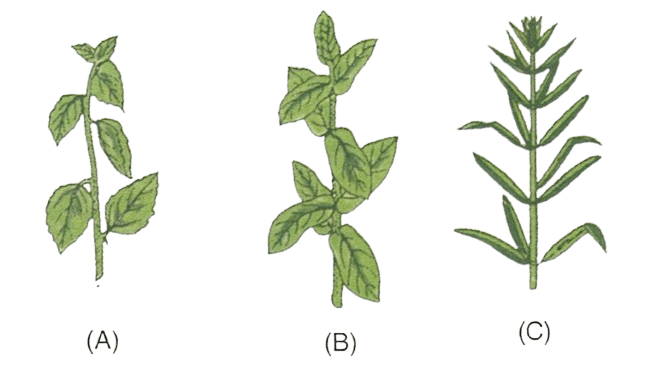
(i) Give a technical term for the arrangement of leaves on the stem.
(ii) Name the three kinds of arrangements shown in the figure A, B and C respectively.
(iii) Give one example of each kind of arrangement.
Draw neat diagrams of the following and give an example of each :
(i) A simple leaf.
(ii) A compound leaf with leaflets arising from different points along the main stalk.
(iii) A compound leaf with leaflets arising from one single point.
(iv) A simple leaf with reticulate venation.
(v) A simple leaf with parallel venation.
Complete the crossword using the clues given below. Check your performance with the correct solutions given at the end of the chapter.
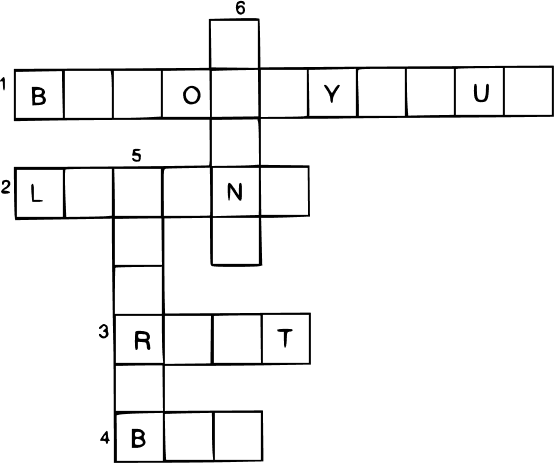
Clues across :
- Plant that bears buds in leaves for propagation.
- The flattened green part of leaf.
- Underground plant part.
- Structure that develops into flower.
Clues down :
- The central big vein of a leaf.
- A modification seen in cactus.