
Mathematics
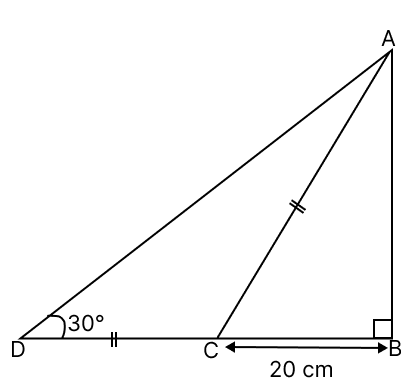
Length of AB is equal to:
cm
cm
20 cm
none of these
Trigonometric Identities
2 Likes
Answer
From figure,
DC = CA = x (let)
By formula,
tan θ =
In triangle ABD,
Since ΔABC is a right angled triangle, using pythagoras theorem,
⇒ Hypotenuse2 = Base2 + Height2
⇒ AC2 = CB2 + AB2
As length of side of triangles cannot be negative. So, x = 40 cm.
DC = AC = x = 40 cm.
cm.
Hence, option 1 is the correct option.
Answered By
2 Likes
Related Questions
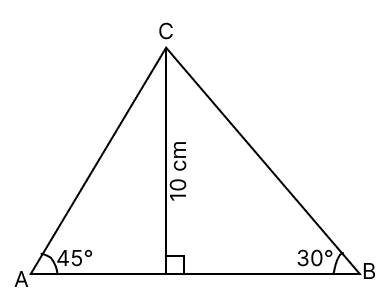
The length of AB is:
20 cm
10 ( - 1) cm
cm
cm
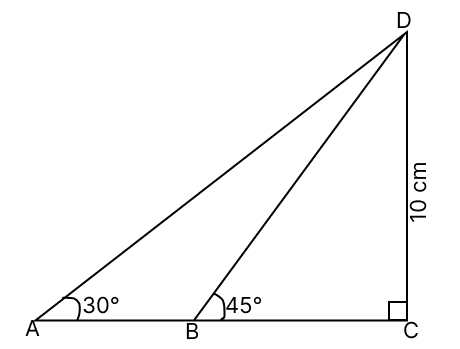
The length of AB is:
(10 - ) cm
10( - 1) cm
10 cm
10( + 1) cm
Statement 1: At a particular time, the length of the shadow of a 50 m tower is m.
Statement 2: The sun's altitude is 30°.
Both the statements are true.
Both the statements are false.
Statement 1 is true, and statement 2 is false.
Statement 1 is false, and statement 2 is true.
Statement 1: The distance between B and C = 5 m.
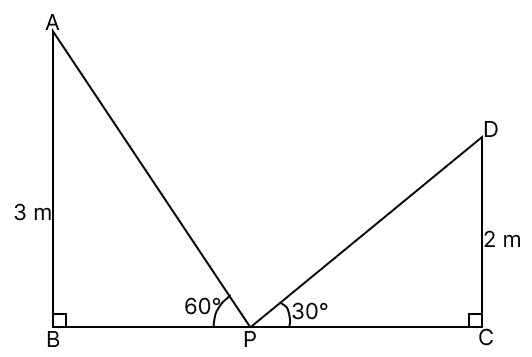
Statement 2: BC = m.
Both the statements are true.
Both the statements are false.
Statement 1 is true, and statement 2 is false.
Statement 1 is false, and statement 2 is true.