Mathematics
If the lengths of three consecutive sides of an isosceles trapezium are 5 cm, 6 cm and 8 cm, then what is the length of the fourth side?
Quadrilaterals
3 Likes
Answer
In an isosceles trapezium, the two non-parallel sides (the legs) are equal in length, while the parallel sides (the bases) are of different lengths.
Let the four consecutive sides be in order: AB, BC, CD and DA, where AB and CD are the two parallel sides and BC and DA are the two non-parallel sides (legs).
Given three consecutive sides are 5 cm, 6 cm and 8 cm.
Let AB = 5 cm, BC = 6 cm and CD = 8 cm.
Since BC and DA are the non-parallel sides of the isosceles trapezium, DA = BC = 6 cm.
∴ The length of the fourth side is 6 cm.
Answered By
3 Likes
Related Questions
State whether the following statements are true or false:
(i) A rectangle is a regular quadrilateral.
(ii) A rhombus is a regular quadrilateral.
(iii) Every parallelogram is a rhombus.
(iv) The diagonals of a rhombus intersect at right angles.
(v) A polygon having 6 sides is called an octagon.
(vi) A road roller has two plane circular faces and one curved face.
(vii) A rectangular pyramid has 5 rectangular faces.
If the lengths of two sides of an isosceles triangle are 3 cm and 7 cm, then what is the length of the third side?
Find out the number of acute angles in each of the figures below:
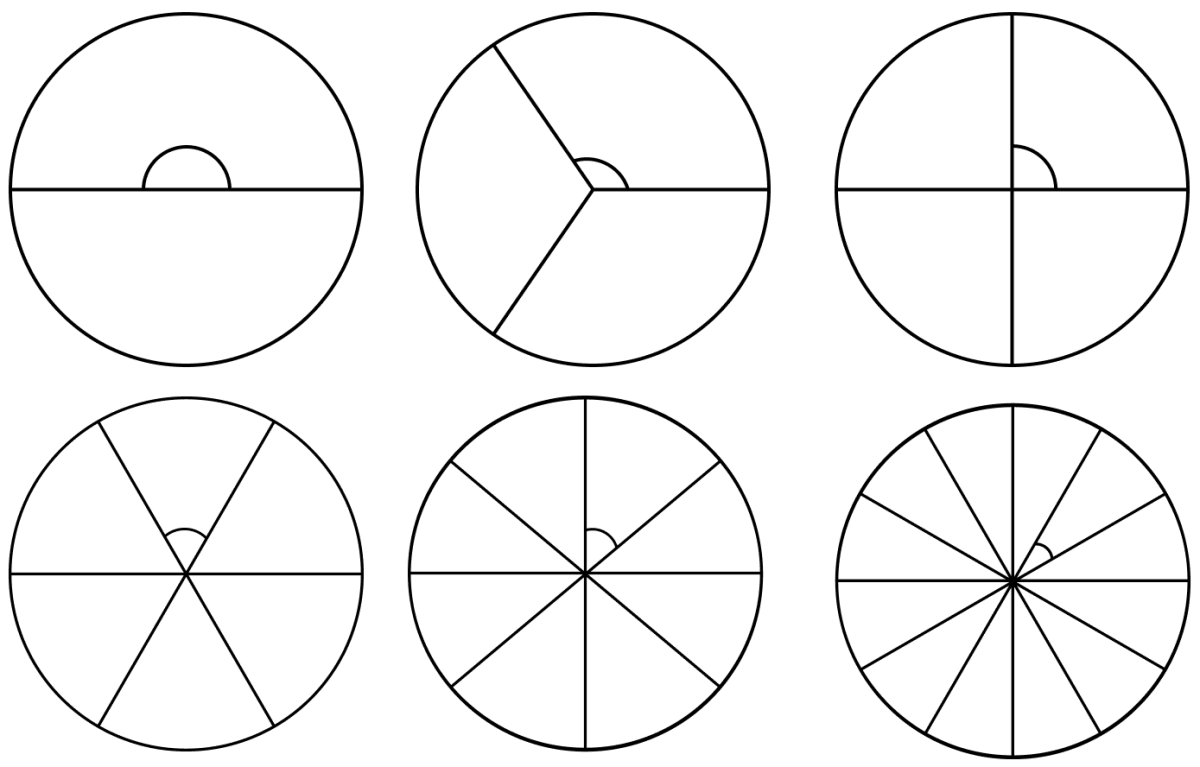
The circle has been divided into 2, 3, 4, 6, 8 and 12 parts below. What are the degree measures of the resulting angles? Do not use protractor to answer this question.