Mathematics
Let P and Q be two sets such that n(P ∪ Q) = 70, n(P) = 45 and n(Q) = 38. Draw a Venn diagram and find :
(i) n(P ∩ Q)
(ii) n(P - Q)
(iii) n(Q - P)
Answer
Given:
n(P ∪ Q) = 70
n(P) = 45
n(Q) = 38
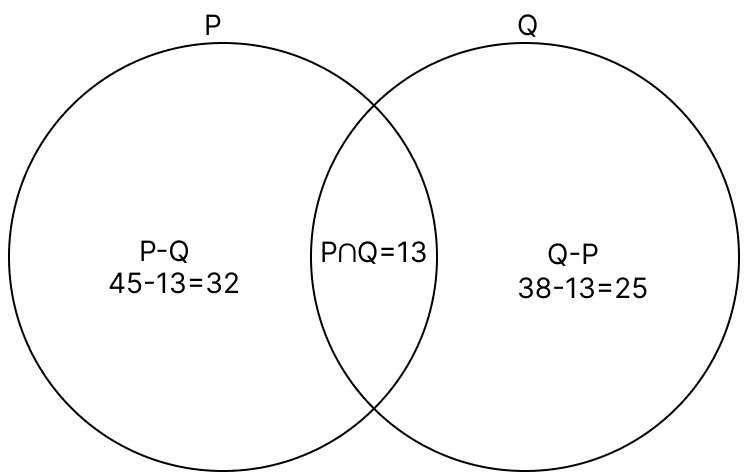
(i) n(P ∩ Q)
To find the number of elements in the intersection, we use the formula:
n(P ∪ Q) = n(P) + n(Q) - n(P ∩ Q)
Rearranging to solve for the intersection:
n(P ∩ Q) = n(P) + n(Q) - n(P ∪ Q)
Substituting the values in above, we get:
n(P ∩ Q) = 45 + 38 - 70
n(P ∩ Q) = 83 - 70
∴ n(P ∩ Q) = 13
(ii) n(P - Q)
This represents elements that are in set P but not in set Q.
We use the formula:
n(P - Q) = n(P) - n(P ∩ Q)
Substituting the values in above, we get:
n(P - Q) = 45 - 13
∴ n(P - Q) = 32
(iii) n(Q - P)
This represents elements that are in set Q but not in set P.
We use the formula:
n(Q - P) = n(Q) - n(P ∩ Q)
Substituting the values in above, we get:
n(Q - P) = 38 - 13
∴ n(Q - P) = 25
Related Questions
Let U = {3, 6, 9, 12, 15, 18, 21, 24} be the universal set and let A = {6, 12, 18, 24} be its subset.
Verify that:
(i) A ∪ A = A
(ii) A ∩ A = A
(iii) A ∩ A' = Φ
(iv) A ∪ A' = U
(v) (A')' = A
Let A and B be two sets such that n(A) = 52, n(B) = 60 and n(A ∩ B) = 16. Draw a Venn diagram and find :
(i) n(A ∪ B)
(ii) n(A - B)
(iii) n(B - A)
In a city, there are 25 Hindi medium schools, 18 English medium schools and 7 schools have both the mediums. Find
(i) how many schools are there in all in the city ;
(ii) how many schools have Hindi medium only ;
(iii) how many schools have English medium only.
There is a group of 50 persons who can speak English or Tamil or both. Out of these persons, 37 can speak English and 30 can speak Tamil.
(i) How many can speak both English and Tamil?
(ii) How many can speak English only?
(iii) How many can speak Tamil only?