
Science
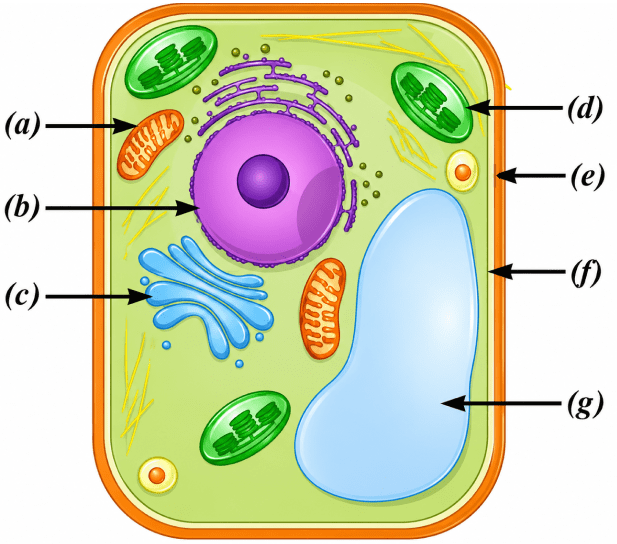
Look at the diagram of a cell in Fig. 2.20. Identify the parts labelled from (a) to (g) and correctly match them with their functions given below:
(i) Controlling all the activities of a cell.
(ii) Site of cellular respiration.
(iii) Storage organelle that also provides rigidity to the cell.
(iv) Separates the cell contents from surroundings.
(v) Provides structural rigidity to the cell.
(vi) Packs and stores materials received from ER.
(vii) Helps in manufacturing food.
Cell
1 Like
Answer
The labelled parts of the plant cell and their matching functions are:
| Label | Part identified | Function |
|---|---|---|
| (a) | Mitochondria | (ii) Site of cellular respiration |
| (b) | Nucleus | (i) Controlling all the activities of a cell |
| (c) | Golgi apparatus | (vi) Packs and stores materials received from ER |
| (d) | Chloroplast | (vii) Helps in manufacturing food |
| (e) | Cell wall | (v) Provides structural rigidity to the cell |
| (f) | Cell membrane | (iv) Separates the cell contents from surroundings |
| (g) | Vacuole | (iii) Storage organelle that also provides rigidity to the cell |
Answered By
1 Like
Related Questions
Differentiate between the following pairs of terms based on the clues given in parentheses:
(i) Cell membrane and cell wall (permeability)
(ii) RER and SER (structure)
(iii) Chloroplasts and chromoplasts (pigments)
Two similar animal cells are placed in two different solutions:
- Cell X is placed in pure water.
- Cell Y is placed in a concentrated salt solution.
Cells are observed after some time. Cell X swells, and Cell Y shrinks. Which statement provides the correct explanation for the above observations?
(i) Salt molecules moved into Cell Y, causing it to shrink.
(ii) Water moved into Cell X and more water moved out of Cell Y than the salt solution entered in it.
(iii) Water moved into Cell X and moved out of Cell Y through the cell membrane.
(iv) Solute movement caused osmosis in both cells.
Which of the following option(s) of the pairs of cell organelles are correctly placed under the given categories?
Option Present in the plant cells Absent in the animal cells (i) Leucoplast Cell wall (ii) Mitochondria Ribosome (iii) Cell wall Golgi apparatus (iv) Lysosome Endoplasmic reticulum Two students, Renu and Rohit, were having a discussion on the plastids. Renu emphasised that all parts of the plants, even roots, contain plastids. However, Rohit did not agree with the statement and told her that plastids are absent in plant roots since the roots are underground and do not need to perform photosynthesis. Who is correct? Justify your answer.