
Science
Two students, Renu and Rohit, were having a discussion on the plastids. Renu emphasised that all parts of the plants, even roots, contain plastids. However, Rohit did not agree with the statement and told her that plastids are absent in plant roots since the roots are underground and do not need to perform photosynthesis. Who is correct? Justify your answer.
Cell
3 Likes
Answer
Renu is correct. Plastids are present in all parts of a plant, including the roots. Rohit's mistake is assuming that all plastids are meant for photosynthesis. In fact, there are different types of plastids:
- Chloroplasts contain chlorophyll and carry out photosynthesis; these are mainly found in the green parts of the plant that are exposed to sunlight.
- Leucoplasts are colourless plastids that store food materials such as starch, oils and proteins. These are found in non-green parts of the plant, including roots.
Since roots are underground and do not perform photosynthesis, they do not contain chloroplasts but they do contain leucoplasts for storage. Therefore, plastids are indeed present in roots, and Renu is correct.
Answered By
2 Likes
Related Questions
Look at the diagram of a cell in Fig. 2.20. Identify the parts labelled from (a) to (g) and correctly match them with their functions given below:
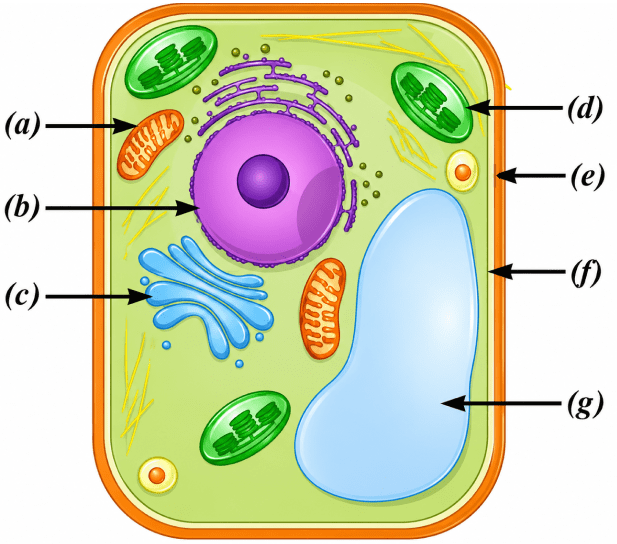
(i) Controlling all the activities of a cell.
(ii) Site of cellular respiration.
(iii) Storage organelle that also provides rigidity to the cell.
(iv) Separates the cell contents from surroundings.
(v) Provides structural rigidity to the cell.
(vi) Packs and stores materials received from ER.
(vii) Helps in manufacturing food.
Which of the following option(s) of the pairs of cell organelles are correctly placed under the given categories?
Option Present in the plant cells Absent in the animal cells (i) Leucoplast Cell wall (ii) Mitochondria Ribosome (iii) Cell wall Golgi apparatus (iv) Lysosome Endoplasmic reticulum Mitochondria and chloroplasts are two important organelles in a plant cell. Discuss how these two organelles are structurally and functionally similar to each other, and different from each other.
Which of the following pairs of cell organelles contains DNA?
(i) Chloroplasts, Ribosomes
(ii) Mitochondria, Nucleus
(iii) Golgi bodies, Ribosomes
(iv) Nucleus, Lysosomes