
Science
Mitochondria and chloroplasts are two important organelles in a plant cell. Discuss how these two organelles are structurally and functionally similar to each other, and different from each other.
Cell
1 Like
Answer
Similarities:
- Both are double-membrane-bound organelles.
- Both have their own DNA and ribosomes, so they can make some of their own proteins.
- Both share an evolutionary history with certain single-celled organisms (bacteria).
- Both are involved in energy-related processes of the cell.
Differences:
| Mitochondria | Chloroplasts |
|---|---|
| Site of cellular respiration, where glucose is broken down to release energy (ATP). | Site of photosynthesis, where food (sugars) is synthesised using sunlight. |
| Present in both plant and animal cells. | Present only in plant cells (green parts). |
| Do not contain chlorophyll. | Contain the green pigment chlorophyll. |
| The inner membrane is folded into finger-like cristae. | Contain a semi-fluid stroma with disc-shaped membrane structures that contain chlorophyll. |
Answered By
2 Likes
Related Questions
Which of the following option(s) of the pairs of cell organelles are correctly placed under the given categories?
Option Present in the plant cells Absent in the animal cells (i) Leucoplast Cell wall (ii) Mitochondria Ribosome (iii) Cell wall Golgi apparatus (iv) Lysosome Endoplasmic reticulum Two students, Renu and Rohit, were having a discussion on the plastids. Renu emphasised that all parts of the plants, even roots, contain plastids. However, Rohit did not agree with the statement and told her that plastids are absent in plant roots since the roots are underground and do not need to perform photosynthesis. Who is correct? Justify your answer.
Which of the following pairs of cell organelles contains DNA?
(i) Chloroplasts, Ribosomes
(ii) Mitochondria, Nucleus
(iii) Golgi bodies, Ribosomes
(iv) Nucleus, Lysosomes
A researcher carried out an experiment in which she took two carrots of similar size. She placed one carrot in plain water and the other carrot in concentrated salt solution (Fig. 2.21). After 24 hours she recorded her observations.
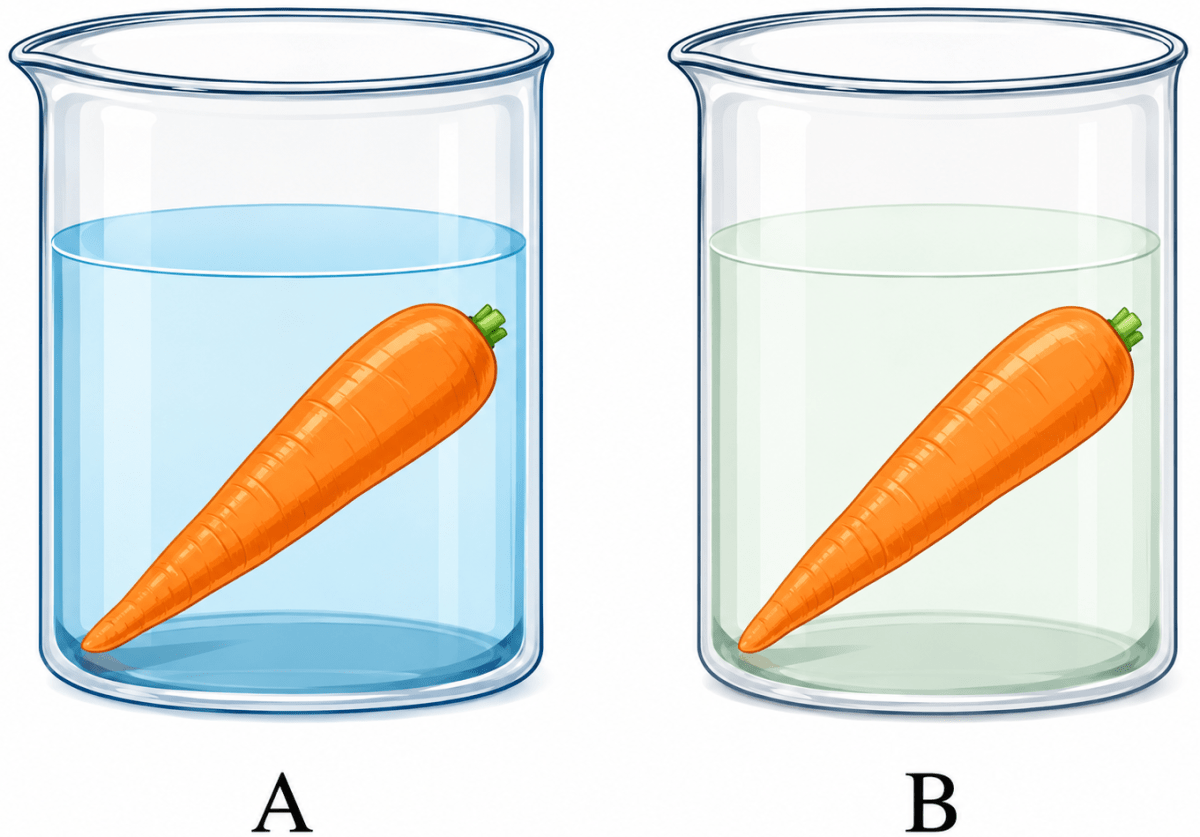
(i) What hypothesis does she want to test through this experiment?
(ii) What would you suggest for the improvement of this experiment?
(iii) Why does the carrot in plain water stay stiff and crunchy, but the carrot in concentrated salt solution become rubbery and limp?