Mathematics
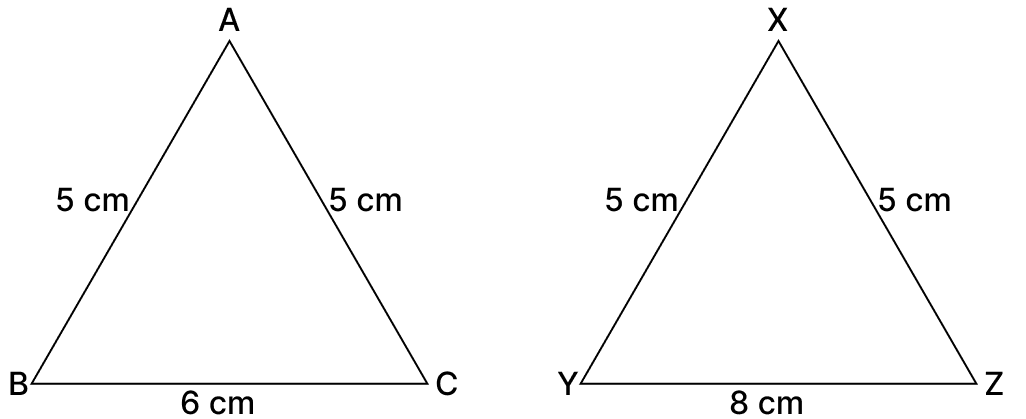
Look at the given triangles. A student argued that since the perimeter of △XYZ is more than that of △ABC, so area of △XYZ is also greater than that of △ABC. Is he right?
Mensuration
1 Like
Answer
From figure,
Perimeter of △ABC = AB + BC + CA = 5 + 5 + 6 = 16 cm
Perimeter of △XYZ = XY + YZ + ZX = 5 + 5 + 8 = 18 cm.
By formula,
Area of an isosceles triangle = , where a is the length of equal sides and b is the length of base.
Area of △ABC =
Area of △XYZ =
Although, perimeter of △XYZ is more than that of △ABC, but area of both the triangles are equal.
Hence, the student is wrong.
Answered By
3 Likes
Related Questions
The base of an isosceles triangle is 16 cm and its area is 48 cm2. The perimeter of the triangle is :
24 cm
30 cm
36 cm
42 cm
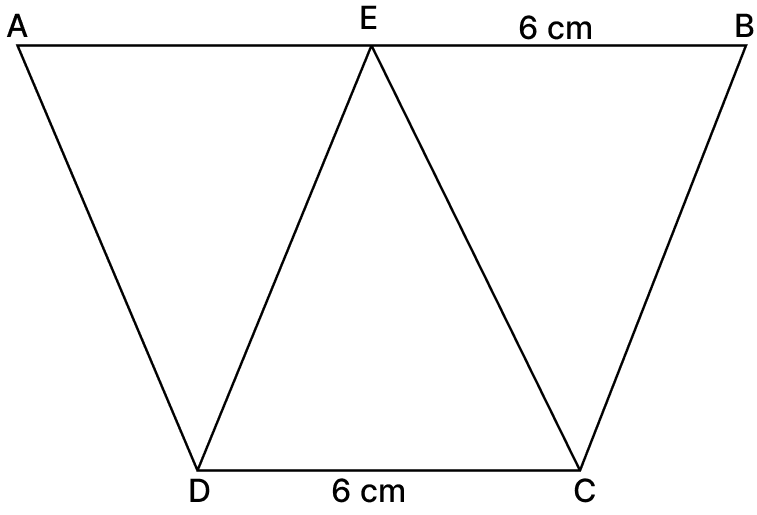
In the given figure, ABCD is a trapezium in which AB || CD. If area of △BEC is 12 cm2, then area of △EDC is :
12 cm2
6 cm2
24 cm2
none of these
A student wrote the Heron's Formula in his notebook as below.
Area of a triangle with sides a, b and c
= .
Is it correct?
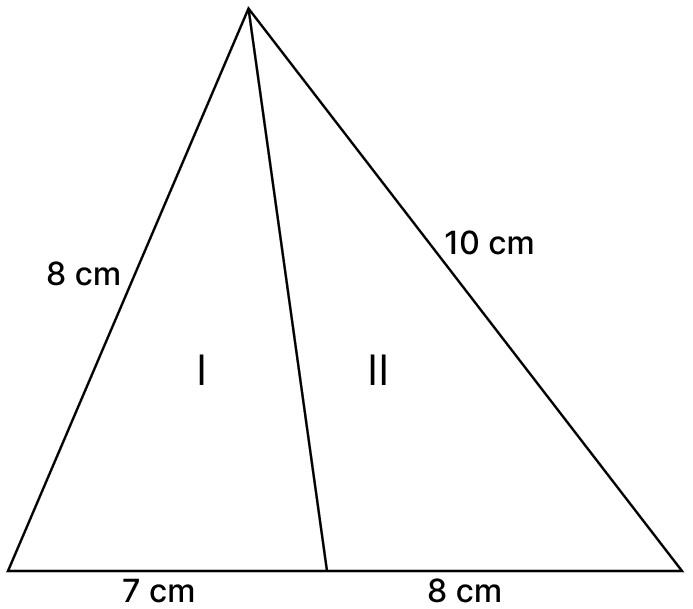
In the figure, semi perimeter of triangle I is known. Would you be able to find the area of triangle II using Heron's formula?