History & Civics
Look at the picture given and answer the following questions:
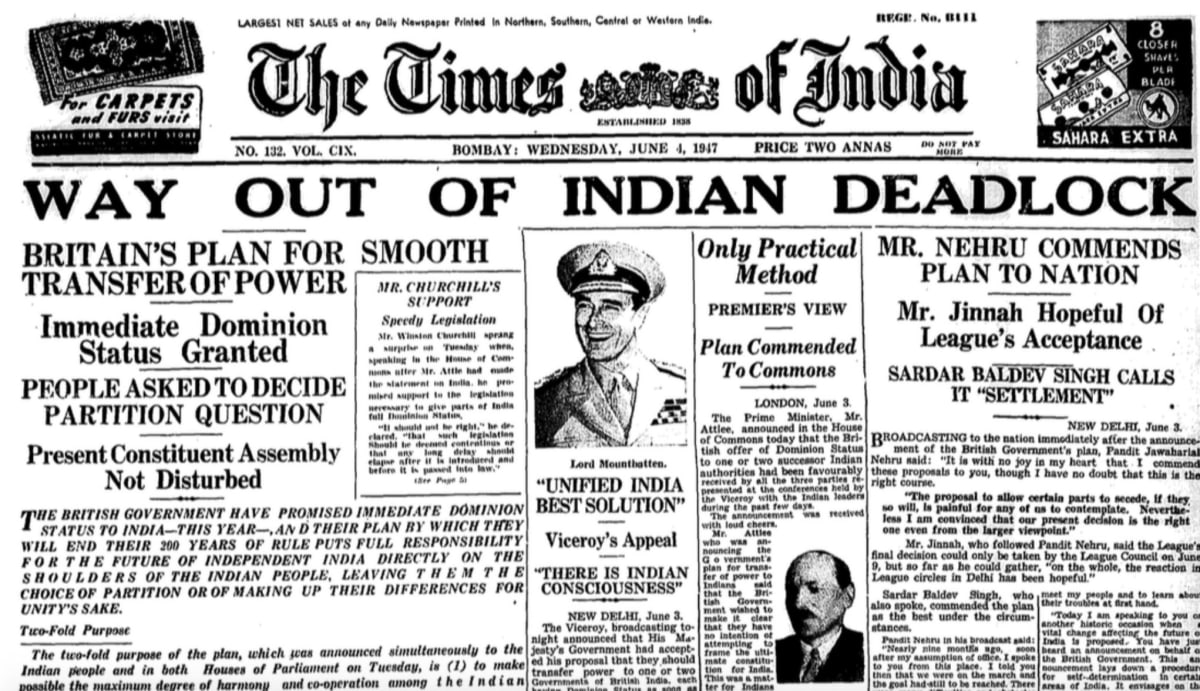
(i) Name the Viceroy who announced the plan for smooth transfer of power. Mention any two clauses of his plan with reference to the Princely States.
(ii) Mention any three reasons for the acceptance of his plan by the Congress.
(iii) Mention any four provisions of the Indian Independence Act of 1947.
Answer
(i) Lord Mountbatten announced the Mountbatten Plan on June 3, 1947, for smooth transfer of power.
Two clauses of Mountbatten Plan with reference to the Princely states are:
- The Mountbatten Plan stated that the treaties with them would come to an end.
- They would be free to associate themselves with either of the Dominions or to remain independent.
(ii) The reasons due to which All-India Congress Committee finally accepted the Mountbatten Plan may be summarised as follows:
- The large-scale communal riots that engulfed the whole country convinced all that the only solution to the communal problem lay in the Partition of India. In the words of Sardar Patel, "Refusal of the demand for Pakistan will amount to dividing the country into so many Pakistans."
- The League had joined the Interim Government to obstruct and not to cooperate. Experience of working with the League had convinced the Congress that it could not have a joint administration with the League.
- The only alternative to Partition was a Federation with a weak Centre. A smaller India with a strong central authority was better than a bigger State with a weak Centre.
(iii) Four provisions of the Indian Independence Act of 1947 are:
Two New Dominions: India would be partitioned and two independent Dominions-India and Pakistan-would be created from August 15, 1947. The Act provided legislative supremacy of both the Dominions. The territories of the two Dominions were divided in such terms that Pakistan would comprise Sindh, British Baluchistan, North West Frontier Province, the West Punjab and East Bengal. India was to comprise all the remaining territories included in the British India. The exact boundaries of the Dominions would be determined by a Boundary Commission.
Constituent Assemblies to Serve as Central Legislatures: The Constituent Assemblies of both the dominions were to act as the Central Legislatures and would have full powers to make laws for their respective Dominion. They would act as sovereign bodies for legislative purposes.
Princely States: The Princely States would become independent and all the powers exercised by the British authority were to be terminated. All treaties and agreements made by the British with reference to States would lapse from August 15, 1947. They would be free to associate themselves with either Dominion or to remain independent.
Division of the Army and the Assets: Provisions were made for the division of the Indian army between the two Dominions and steps were to be taken to share the assets and liabilities between the two Dominions.
Related Questions
The Revolt of 1857 was the beginning of the independence struggle against the colonial rule of the British. With reference to the consequences of the Revolt, answer the following:
(i) Mention any three changes made in the administration with the end of the Company's Rule.
(ii) State any three policies promised to Indians in Queen Victoria's Proclamation.
(iii) Mention any four changes made in the army after the Revolt.
The Indian National Movement is divided into three phases. With reference to the Second Phase of the Indian National Movement, answer the following questions:
(i) Who partitioned Bengal? Mention any two points to explain the perspective of the Nationalists regarding the actual motive behind the decision of Partition.
(ii) What was the objective of the Assertive Nationalists? Mention any two contributions of Bal Gangadhar Tilak.
(iii) In which year was the Muslim League formed? Mention any three objectives of the Muslim League.
The final act of the long-drawn-out negotiations took place at Versailles on Saturday afternoon, and to-day Germany and the Allies - always with the exception of America - are at peace. Peace is a blessed word, and both the word and the fact are welcome to-day. So far as Germany is concerned there is for the present an end of strife, and at least a formal return to the decent relations of civilised states.
Editorial: Peace in force (12 January 1920)
The Guardian
(a) Mention any three causes of the World War which ended with the signing of the treaty being discussed in the passage above.
(b) Name the organisation which was established in 1920 to maintain peace after this war. Mention any two of its objectives.
(c) Mention any four clauses of the Treaty which affected Germany.
Both the United Nations Organisation and the Non-Aligned Movement aim to achieve international peace and security. In this context, answer the following:
(i) Mention any three functions of the Security Council.
(ii) Mention any three functions of the World Health Organisation.
(iii) Name any two founders of the Non-Aligned Movement. Mention any two of its objectives.