
Mathematics
M and N are the mid-points of the sides QR and PQ respectively of a △ PQR, right-angled at Q. Prove that :
(i) PM2 + RN2 = 5 MN2
(ii) 4 PM2 = 4 PQ2 + QR2
(iii) 4 RN2 = PQ2 + 4 QR2
(iv) 4 (PM2 + RN2) = 5 PR2
Pythagoras Theorem
88 Likes
Answer
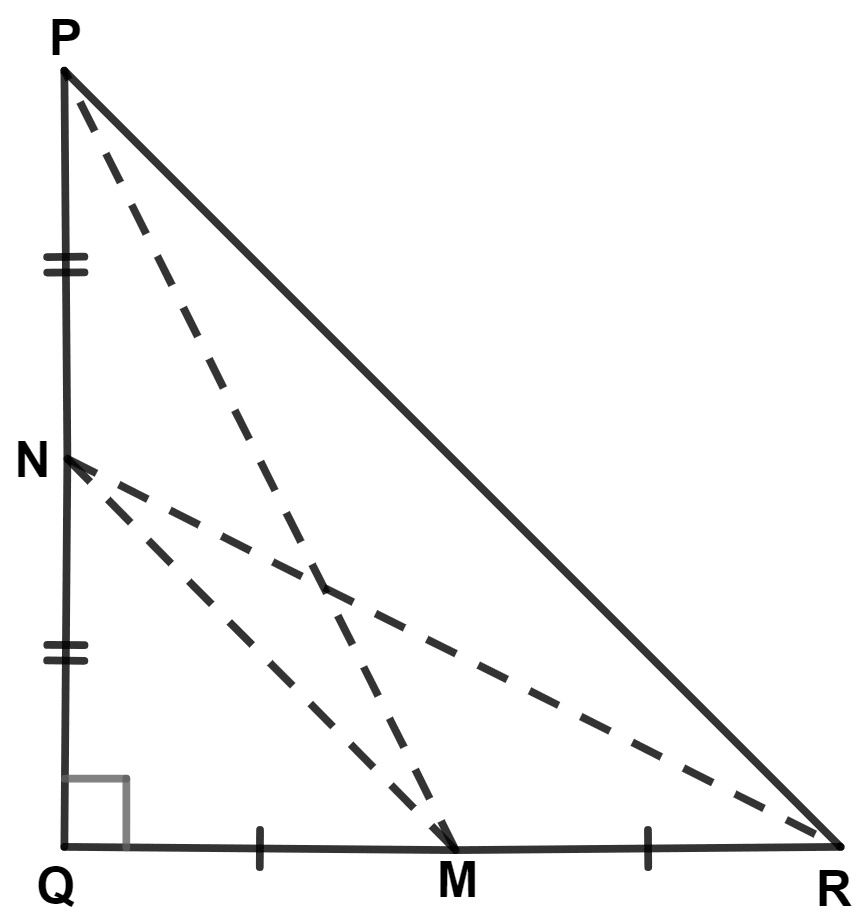
Since, M and N are the mid-points of the sides QR and PQ respectively.
PN = NQ and QM = RM
(i) In △ MNQ,
By pythagoras theorem,
⇒ MN2 = NQ2 + QM2 ……….(1)
In △ PQM,
By pythagoras theorem,
⇒ PM2 = PQ2 + QM2
⇒ PM2 = (PN + NQ)2 + QM2
⇒ PM2 = PN2 + NQ2 + 2.PN.NQ + QM2
⇒ PM2 = MN2 + PN2 + 2.PN.NQ [From equation (1)] ………..(2)
In △ RNQ,
By pythagoras theorem,
⇒ RN2 = NQ2 + RQ2
⇒ RN2 = NQ2 + (QM + RM)2
⇒ RN2 = NQ2 + QM2 + RM2 + 2.QM.RM
⇒ RN2 = MN2 + RM2 + 2.QM.RM [From equation (1)] ………..(3)
Adding equations (2) and (3), we get :
⇒ PM2 + RN2 = MN2 + PN2 + 2.PN.NQ + MN2 + RM2 + 2.QM.RM
⇒ PM2 + RN2 = 2MN2 + PN2 + RM2 + 2.PN.NQ + 2.QM.RM
Substituting PN = QN and RM = QM in above equation, we get :
⇒ PM2 + RN2 = 2MN2 + QN2 + QM2 + 2.NQ.NQ + 2.QM.QM
⇒ PM2 + RN2 = 2MN2 + QN2 + QM2 + 2 QN2 + 2 QM2
⇒ PM2 + RN2 = 2MN2 + (QN2 + QM2) + 2 (QN2 + QM2)
⇒ PM2 + RN2 = 2MN2 + MN2 + 2MN2 [From equation (1)]
⇒ PM2 + RN2 = 5MN2.
Hence, proved that PM2 + RN2 = 5MN2.
(ii) In △ PQM,
By pythagoras theorem,
⇒ PM2 = PQ2 + QM2
Multiplying both sides of the above equation by 4, we get :
⇒ 4PM2 = 4PQ2 + 4QM2
⇒ 4PM2 = 4PQ2 +
⇒ 4PM2 = 4PQ2 +
⇒ 4PM2 = 4PQ2 + QR2.
Hence, proved that 4PM2 = 4PQ2 + QR2.
(iii) In △ RQN,
By pythagoras theorem,
⇒ RN2 = NQ2 + QR2
Multiplying both sides of the above equation by 4, we get :
⇒ 4RN2 = 4NQ2 + 4QR2
⇒ 4RN2 = 4QR2 +
⇒ 4RN2 = 4QR2 +
⇒ 4RN2 = 4QR2 + PQ2.
Hence, proved that 4RN2 = PQ2 + 4QR2.
(iv) Proved in part (i), we get :
⇒ PM2 + RN2 = 5MN2
Multiplying both side of the above equation by 4, we get :
⇒ 4(PM2 + RN2) = 4 × 5 MN2
⇒ 4(PM2 + RN2) = 4 × 5 (NQ2 + MQ2)
⇒ 4(PM2 + RN2) = 4 × 5
⇒ 4(PM2 + RN2) = 4 × 5
⇒ 4(PM2 + RN2) = 4 × 5 (PQ2 + RQ2)
⇒ 4(PM2 + RN2) = 5 (PQ2 + RQ2) …..(4)
In right angled triangle PQR,
By pythagoras theorem,
⇒ PR2 = PQ2 + RQ2
Substituting above value of PR2 in equation (4), we get :
⇒ 4(PM2 + RN2) = 5 PR2.
Hence, proved that 4(PM2 + RN2) = 5 PR2.
Answered By
32 Likes
Related Questions
In equilateral △ ABC, AD ⊥ BC and BC = x cm. Find, in terms of x, the length of AD.
ABC is a triangle, right-angled at B. M is a point on BC. Prove that :
AM2 + BC2 = AC2 + BM2.
In triangle ABC, ∠B = 90° and D is the mid-point of BC. Prove that : AC2 = AD2 + 3CD2.
In a rectangle ABCD, prove that :
AC2 + BD2 = AB2 + BC2 + CD2 + DA2.