
Mathematics
In equilateral △ ABC, AD ⊥ BC and BC = x cm. Find, in terms of x, the length of AD.
Pythagoras Theorem
65 Likes
Answer
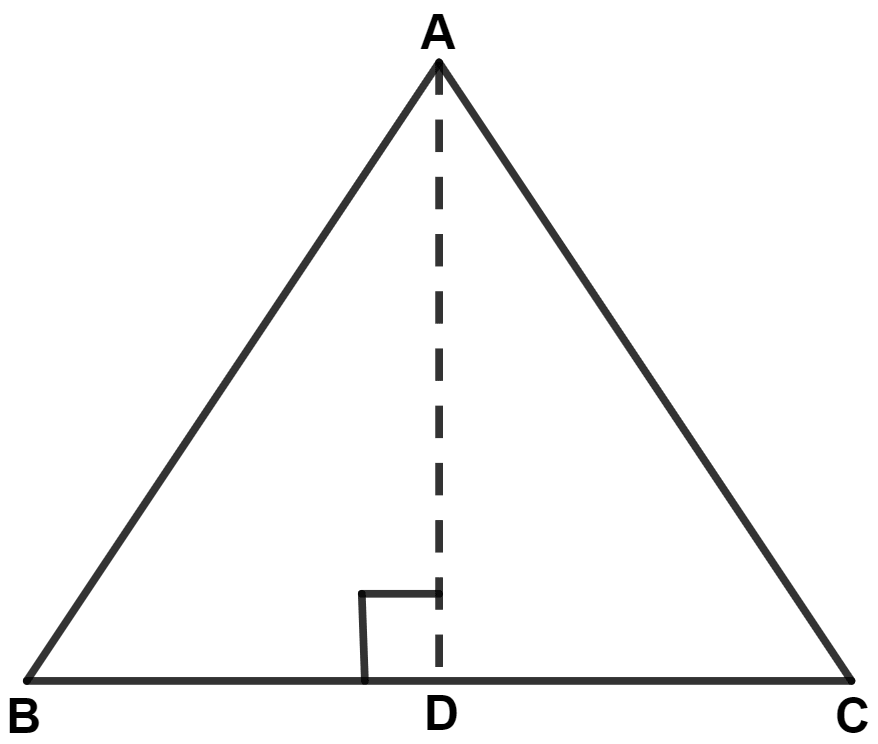
In △ ABD and △ ACD,
⇒ ∠ADB = ∠ADC (Both equal to 90°)
⇒ AD = AD (Common side)
⇒ AB = AC (Since, ABC is an equilateral triangle)
∴ △ ABD ≅ △ ACD (By S.A.S. axiom)
We know that,
Corresponding parts of congruent triangle are equal.
∴ BD = CD = cm.
In right-angled triangle ABD,
By pythagoras theorem,
⇒ (Hypotenuse)2 = (Perpendicular)2 + (Base)2
⇒ AB2 = AD2 + BD2
⇒ x2 = AD2 +
⇒ AD2 = x2 -
⇒ AD2 =
⇒ AD2 =
⇒ AD2 =
⇒ AD = cm.
Hence, AD = cm.
Answered By
43 Likes
Related Questions
ABC is an isosceles triangle right-angled at C. Then 2AC2 is equal to :
BC2
AC2
AC2 - BC2
AB2
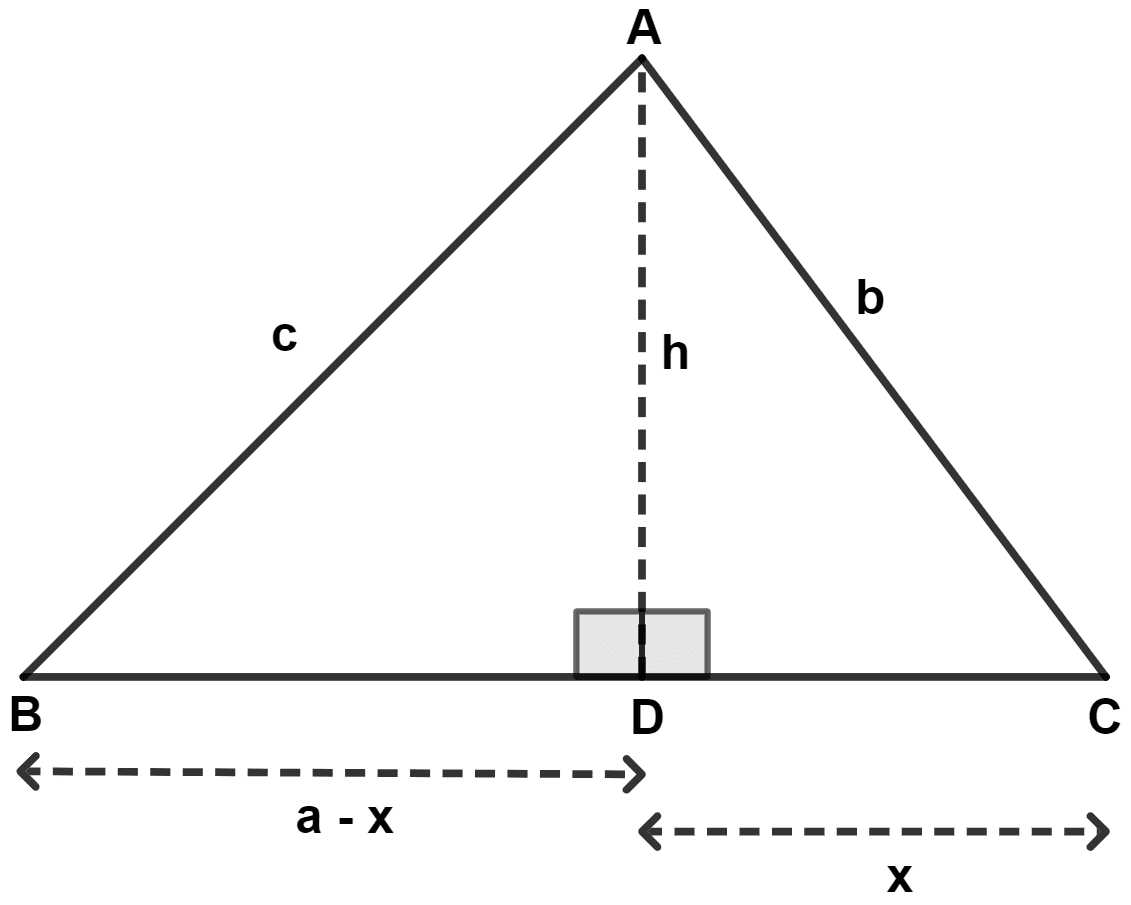
In the figure, given below, AD ⊥ BC. Prove that :
c2 = a2 + b2 - 2ax.
ABC is a triangle, right-angled at B. M is a point on BC. Prove that :
AM2 + BC2 = AC2 + BM2.
M and N are the mid-points of the sides QR and PQ respectively of a △ PQR, right-angled at Q. Prove that :
(i) PM2 + RN2 = 5 MN2
(ii) 4 PM2 = 4 PQ2 + QR2
(iii) 4 RN2 = PQ2 + 4 QR2
(iv) 4 (PM2 + RN2) = 5 PR2