Chemistry
Some main features of the structure of an atom are :
(i) Atoms of all the elements (except hydrogen) are made up of three fundamental (sub-atomic) particles: electrons, protons and neutrons. (Hydrogen atom lacks neutrons).
(ii) The nucleus is located at the centre of the atom. It contains protons and neutrons, which account for the total mass of that atom.
(iii) The nucleus is positively charged due to the presence of protons in it.
(iv) The electrons are outside the nucleus and have negligible mass.
Answer the following:
(a) What is the charge of nucleus ? Give reason.
(b) Atom is positively charged, negatively charged or neutral ? Why ?
(c) Why do only protons and neutrons account for the total mass of an atom ?
(d) What do you mean by orbits ?
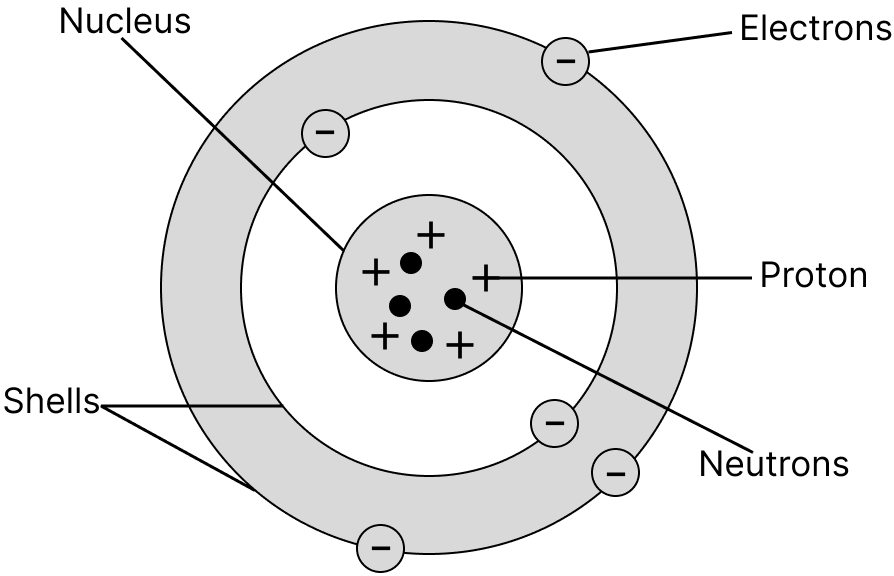
(e) Draw a figure showing the 3 fundamental particles in an atom.
Answer
(a) The nucleus is positively charged because it contains protons, which have positive charge and neutrons, which have no charge.
(b) An atom is electrically neutral because the total positive charge of the nucleus is balanced by the total negative charge of the electrons.
(c) Protons and neutrons account for almost all the mass because they are much heavier than electrons. Electrons have negligible mass compared to protons and neutrons, so their contribution to the total mass is very small and usually ignored.
(d) Orbits are fixed paths or energy levels around the nucleus in which electrons move. These are also called shells or energy levels.
(e)
Related Questions
Assertion (A): The properties of an ion are different from that of the parent atom.
Reason (R): Atoms and ions differ with respect to the number of neutrons and protons in them.
- Both A and R are true and R is the correct explanation of A.
- Both A and R are true but R is not the correct explanation of A.
- A is true but R is false.
- A is false but R is true.
Assertion (A): The valency of an element is its combining capacity with an atom of another element.
Reason (R): Elements take part in chemical combination to acquire the electronic configuration of the nearest noble gas.
- Both A and R are true and R is the correct explanation of A.
- Both A and R are true but R is not the correct explanation of A.
- A is true but R is false.
- A is false but R is true.
Electronic configuration is the distribution of electrons in the various energy shells of an atom. It is based on the Bohr-Bury scheme, which states that :
- The maximum number of electrons that can be accommodated in a shell is given by 2n2, where n is the shell number.
- The outermost shell cannot have more than 8 electrons.
- A new shell starts filling once the inner shell acquires eight electrons.
Based on the information given above, answer the following questions:
(a) Write the electronic configuration of an atom X with atomic number 19.
(b) Draw the orbital diagram of the ion formed by atom X.
(c) Draw the complete orbital diagrams of the atoms 35Cl and 37Cl.
(d) Which fundamental particle differs in the atoms mentioned in part (c)?
(e) State the general term used for the atoms given in part (c).
An element Y has electronic configuration 2, 8, 2.
Another element X has electronic configuration (2, 8, 7). The number of valence electrons of Y is 2 and that of X is 7. An atom of Y acquires a stable configuration of 8 electrons by losing two electrons from its outermost shell (one each to each atom of X) and thus becomes a positive ion, Y2+.However an atom of X, which contains 7 electrons in its outermost shell, can accept only 1 of the 2 electrons donated by an atom of Y. Therefore, for each Y atom forming a Y2+ ion, there must be two X atoms to form two X- ions.
(a) Which type of bond does this compound form ?
(b) In the formation of the compound …………… (transfer/sharing) of electrons takes place.
(c) Name two other compounds that form this type of a bond.
(d) Draw the orbital diagram for the formation of this compound.
(e) This type of bond is formed between …………… (metals and metals/metals and non metals/non metals and non metals).
(f) Can the above compound conduct electricity ?