
Mathematics
The mean age of nine boys is 28 years and if one new boy joins them the mean age increases by one.
Assertion(A): The age of new boy is (29 x 10 - 28 x 9) years.
Reason(R): The age of new boy is (29 - 28) x 10 years.
A is true, R is false.
A is false, R is true.
Both A and R are true and R is correct reason for A.
Both A and R are true and R is incorrect reason for A.
Measures of Central Tendency
4 Likes
Answer
Given, the mean age of 9 boys is 28 years.
when one new boy joins, the mean age increases by 1 year, making the new mean 29 years
By formula,
Mean =
The mean age of 9 boys is 28 years.
After the new boy joins, the mean age becomes 29 years for 10 boys.
The age of the new boy is the difference between the total age of 10 boys and the total age of 9 boys = 29 x 10 - 28 x 9
∴ A is true, R is false.
Hence, option 1 is the correct option.
Answered By
3 Likes
Related Questions
The median of first six prime numbers is :
5
7
6
7.5
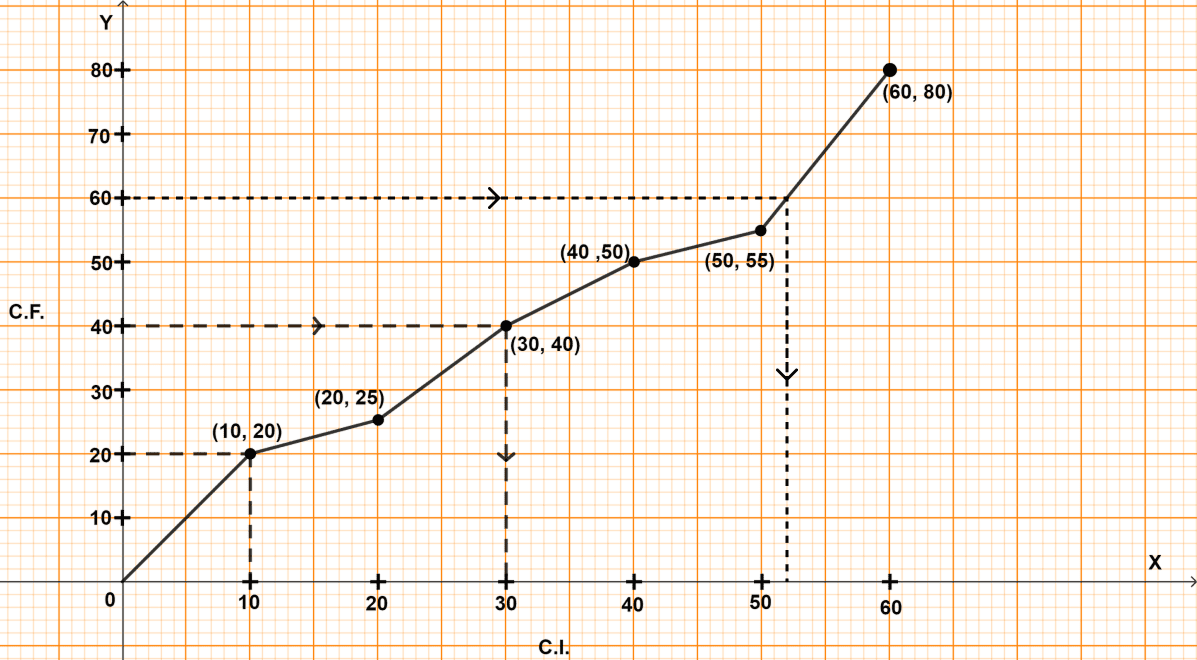
The inter quartile range for the given ogive is :
42
32
44
54
Data = 37, 41, 56, 62, 70, 74, 81, 89, 95 and 90.
Assertion(A): Median = 72.
Reason(R): If number of data(n) is odd, the median = term.
A is true, R is false.
A is false, R is true.
Both A and R are true and R is correct reason for A.
Both A and R are true and R is incorrect reason for A.
C.I. 0 - 10 10 - 20 20 - 30 Frequency 15 25 b Cumulative frequency 15 a 50 Assertion(A): a = 15 + 25 = 40
b = 50 - a
Reason(R): a + 15 = 25
and b = 50 - 10
A is true, R is false.
A is false, R is true.
Both A and R are true and R is correct reason for A.
Both A and R are true and R is incorrect reason for A.