
Mathematics
The mid-points of the sides BC, CA and AB of ΔABC are D(2, 1), E(-1, -3) and F(4, 5) respectively. Find the co-ordinates of A, B and C.
Section Formula
2 Likes
Answer
Let the vertices of ΔABC be A(x1, y1), B(x2, y2), and C(x3, y3).
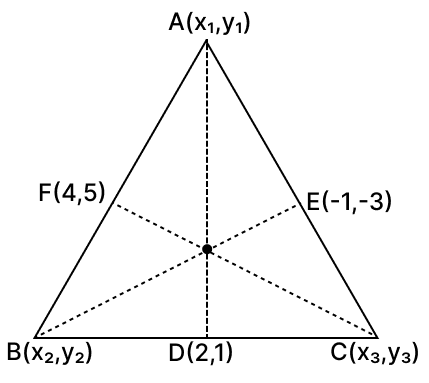
By mid-point formula,
(x, y) =
Given,
D(2, 1) is the midpoint of BC.
Substitute values we get,
Given,
E(-1, -3) is the midpoint of CA.
Given,
F(4, 5) is the midpoint of CA.
Adding the three equations (1), (3) and (5), we get :
⇒ (x2 + x3) + (x3 + x1) + (x1 + x2) = 4 + (-2) + 8
⇒ 2x1 +2x2 + 2x3 = 10
⇒ 2(x1 +x2 + x3) = 10
⇒ (x1 +x2 + x3) =
⇒ (x1 +x2 + x3) = 5 …..(7)
Subtract (Eq. 3) from (Eq. 7) :
⇒ (x1 +x2 + x3) - ( x2 + x3) = 5 - 4
⇒ (x1 +x2 + x3 -x2 - x3) = 5 - 4
⇒ x1 = 1.
Subtract (Eq. 2) from (Eq. 7) :
⇒ (x1 +x2 + x3) - ( x3 + x1) = 5 - (-2)
⇒ (x1 +x2 + x3 -x3 - x1) = 5 + 2
⇒ x2 = 7.
Subtract (Eq. 5) from (Eq. 7):
⇒ (x1 +x2 + x3) - ( x1 + x2) = 5 - 8
⇒ (x1 +x2 + x3 -x1 - x2) = -3
⇒ x3 = -3.
Adding equations (2), (4) and (5), we get :
⇒ (y2 + y3) + (y3 + y1) + (y1 + y2) = 2 + (-6) + 10
⇒ 2y1 +2y2 + 2y3 = 6
⇒ 2(y1 +y2 + y3) = 6
⇒ (y1 +y2 + y3) =
⇒ (y1 +y2 + y3) = 3 …..(8)
Subtract (Eq. 2) from (Eq. 8):
⇒ (y1 +y2 + y3) - ( y2 + y3) = 3 - 2
⇒ (y1 +y2 + y3 -y2 - y3) = 1
⇒ y1 = 1.
Subtract (Eq. 4) from (Eq. 8):
⇒ (y1 + y2 + y3) - ( y3 + y1) = 3-(-6)
⇒ (y1 +y2 + y3 -y3 - y1) = 3 + 6
⇒ y2 = 9.
Subtract (Eq. 6) from (Eq. 8):
⇒ (y1 + y2 + y3) - ( y1 + y2) = 3 - 10
⇒ (y1 +y2 + y3 -y1 - y2) = -7
⇒ y3 = -7.
⇒ A = (x1, y1) = (1, 1), B = (x2, y2) = (7, 9), C = (x3, y3) = (-3, -7).
Hence, A = (1, 1), B = (7, 9) and C = (-3, -7).
Answered By
1 Like
Related Questions
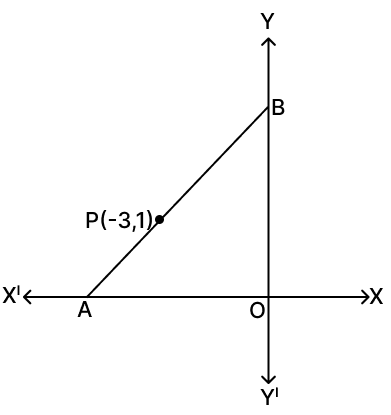
In the given figure, the line segment AB meets x-axis at A and y-axis at B. The point P(-3, 1) on AB divides it in ratio 2 : 3. Find the coordinates of A and B.
Show that the line segment joining the points A(-5, 8) and B(10, -4) is trisected by the coordinate axes. Also, find the points of trisection of AB.
Prove that the points A(-2, -1), B(1, 0), C(4, 3) and D(1, 2) are the vertices of a parallelogram ABCD.
If the points A(-2, -1), B(1, 0), C(a, 3) and D(1, b) form a parallelogram, find the values of a and b.