
Physics
(a) Name the radiations that are emitted during the decay of a nucleus, which has highest penetrating power?
(b) Does the emission of the above-mentioned radiation result in a change in the mass number?
Radioactivity
21 Likes
Answer
(a) Gamma (γ) radiation.
(b) No, the emission of gamma radiation does not result in a change in the mass number as they are a form of electromagnetic radiation, essentially high-energy photons, and they have no mass or charge. Since they are massless, their emission does not affect the number of protons or neutrons in the nucleus, and therefore the mass number remains unchanged.
Answered By
14 Likes
Related Questions
A solid of mass 60 g at 100°C is placed in 150 g of water at 20°C. The final steady temperature is 25°C. Calculate the heat capacity of solid.
[Specific heat capacity of water = 4.2 Jg⁻¹K⁻¹]
(a) Name the principle of AC generator.
(b) State its one use.
The graph (fig A) illustrates the correlation between the number of protons (x-axis) and the number of neutrons (y-axis) for elements A, В, C, D, and E in the periodic table. These elements are denoted by the letters rather than their conventional symbols. When the element C, depicted in the graph, undergoes radioactive decay, it releases radioactive rays. When these rays are directed into the plane of the paper in the presence of a magnetic field, as indicated in the fig B, they experience deflection, causing them to move upwards.
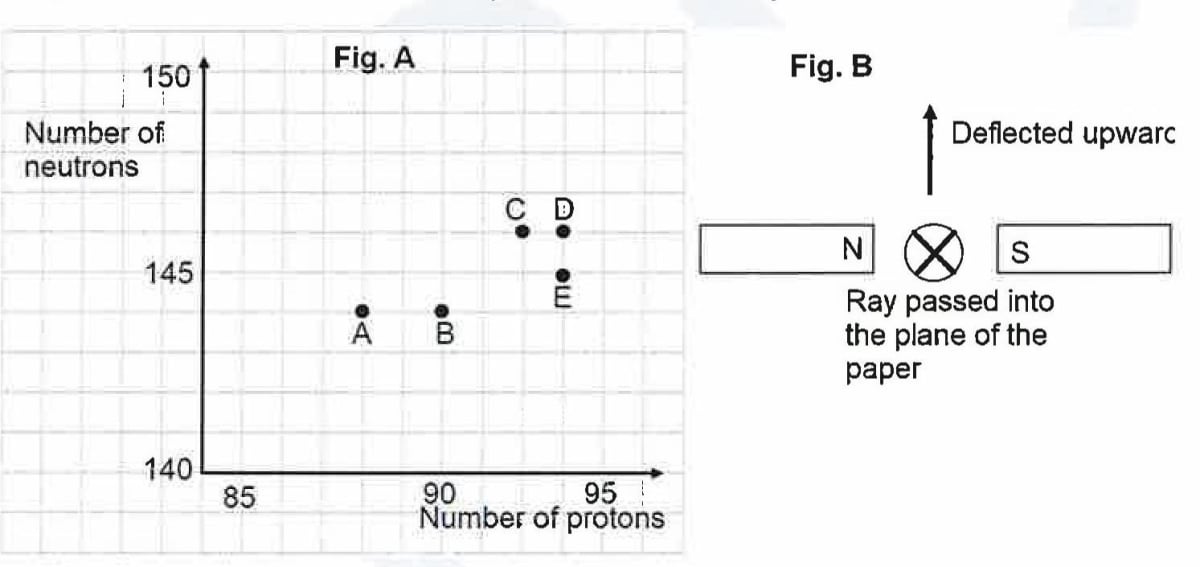
(a) Name the radioactive radiations emitted by the element C.
(b) Identify the daughter element from the graph.
(c) Name the law used to identify the radioactive radiations emitted by the element.
The diagram below shows a fish in the tank and its image seen in the surface of water.
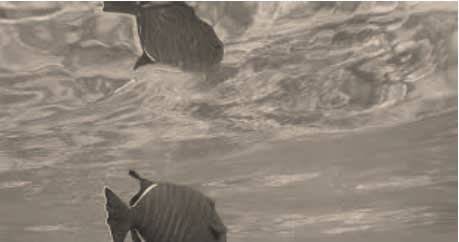
(a) Name the phenomenon responsible for the formation of this image.
(b) A double convex lens with refractive index μ1 inside two liquids of refractive indices μ2 and μ3 are shown in the diagrams below. The refractive indices are such that μ2 > μ1 and μ1 > μ3

How would a parallel incident beam of light refract when it comes out of the lens in each of the cases shown above?
(1) in figure a.
(2) in figure b.