
Physics
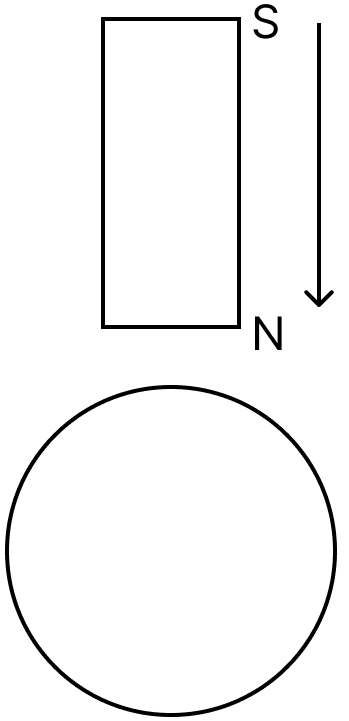
The north pole of a magnet is brought near a metallic ring as shown in the figure given below. The direction of induced current will be :
- anticlockwise
- clockwise
- first anticlockwise and then clockwise
- first clockwise and then anticlockwise
Electro-Magnetism
3 Likes
Answer
anticlockwise
Reason — As the north pole of the magnet is brought closer to the metallic ring, the magnetic flux through the ring increases.
According to Lenz’s law, the induced current flows in such a direction as to oppose this increase in flux so to oppose the approaching north pole, the face of the ring towards the magnet must behave like a north pole.
For a circular loop, this happens when the current flows anticlockwise (as seen from the magnet side).
Hence, the direction of induced current will be anticlockwise.
Answered By
3 Likes
Related Questions
(i) The number of turns in the secondary coil of a transformer is 20 times than that in a primary coil. If the power fed to the primary coil is 100 W (assume no energy loss), then what is the power output at the secondary coil ?
- 5 W
- 100 W
- 2000 W
- 4000 W
(ii) If the primary coil of the above transformer is supplied with 10 V, what is the voltage of the secondary coil ?
- 0.5 V
- 10 V
- 200 V
- 100 V
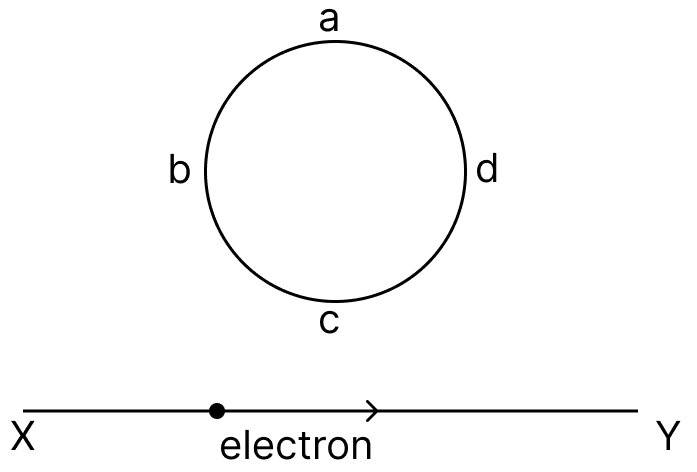
An electron moves on a straight line path XY as shown. abcd is a coil adjacent to the path of electron. The direction of induced current, if any, in the coil will be :
- No curent is induced
- abcd
- adcb
- No fixed direction
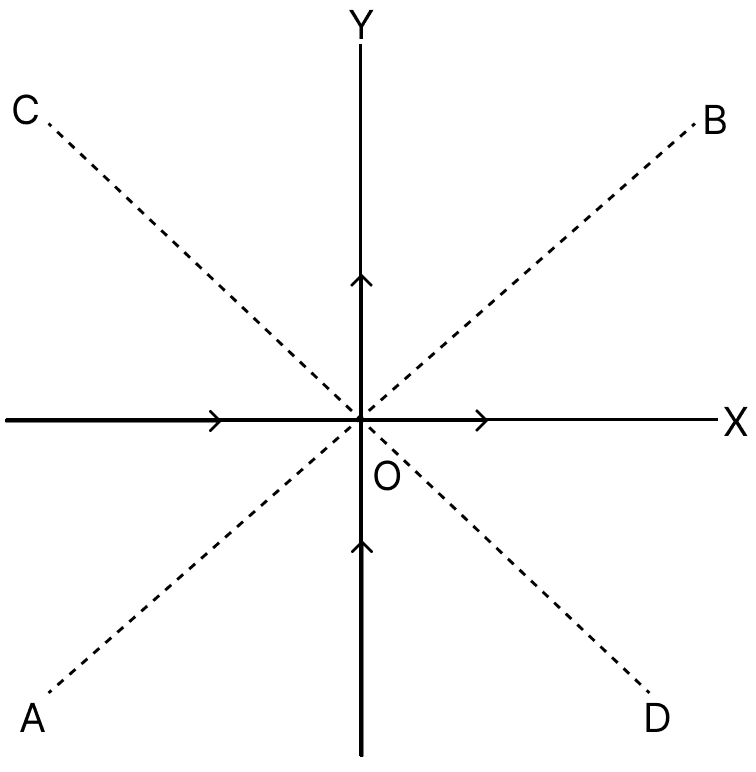
Two thin wires carrying same currents lie on X and Y axis as shown in the figure. The origin of axis is O. The magnetic field will be zero on line :
- AB
- CB
- part OB of line AB
- part OC of line CD
Assertion (A): A current carrying solenoid when suspended freely sets itself in the north-south direction just like a bar magnet.
Reason (R): The end of the solenoid where the direction of current is anti-clockwise behaves as a north pole and the end where the direction of the current is clockwise behaves as a south pole.
- Both A and R are true and R is the correct explanation of A.
- Both A and R are true and R is not the correct explanation of A.
- assertion is false but reason is true.
- assertion is true but reason is false.