
Physics
(i) The number of turns in the secondary coil of a transformer is 20 times than that in a primary coil. If the power fed to the primary coil is 100 W (assume no energy loss), then what is the power output at the secondary coil ?
- 5 W
- 100 W
- 2000 W
- 4000 W
(ii) If the primary coil of the above transformer is supplied with 10 V, what is the voltage of the secondary coil ?
- 0.5 V
- 10 V
- 200 V
- 100 V
Electro-Magnetism
1 Like
Answer
(i) 100 W
(ii) 200 V
Reason —
(i) In an ideal transformer (no energy loss), the input power equals output power. Therefore, even though the number of turns changes, the power remains the same.
Hence, the secondary coil also delivers 100 W.
(ii) Given,
- Ratio of number of turns in the secondary coil to the primary coil = 20
- Voltage of the primary coil = 10 V
In a transformer, voltage is proportional to the number of turns i.e.,
Hence, the voltage of the secondary coil is 200 V.
Answered By
1 Like
Related Questions
Out of the following, which statement is incorrect ?
- The lamination of core prevents loss of energy due to eddy currents.
- The core is made of soft iron.
- A transformer can be used with d.c.
- A closed core is used so as to provide a closed path for magnetic field lines.
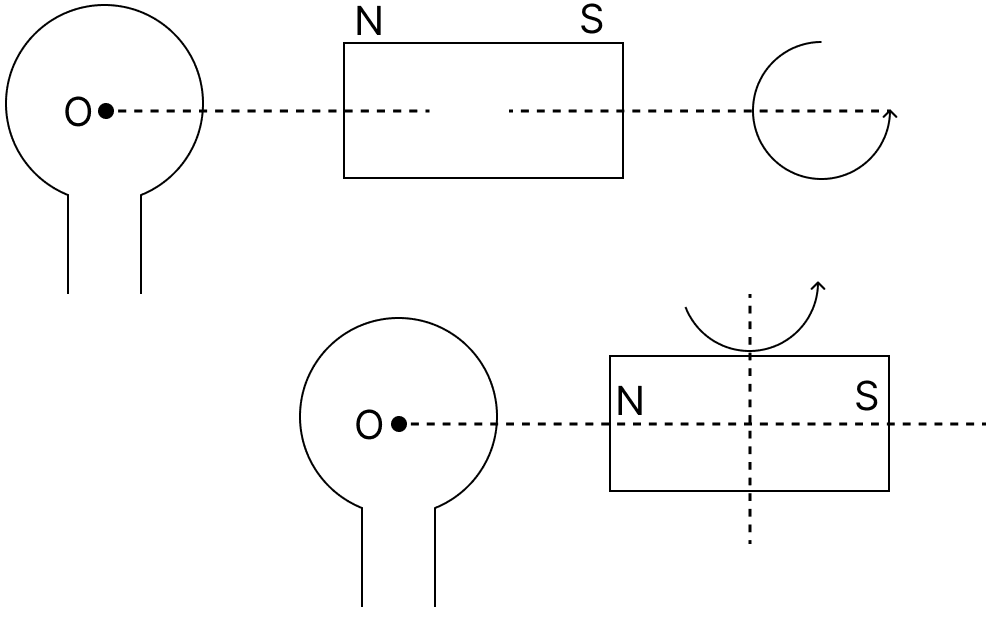
A bar magnet is kept along the axis of a circular coil as shown in the figure given below. The magnet is rotated (i) about its own axis and (ii) about an axis perpendicular to the length of the magnet. The induced emf is generated at the terminals of the coil in :
- (i) only
- (ii) only
- none of the cases
- both the cases
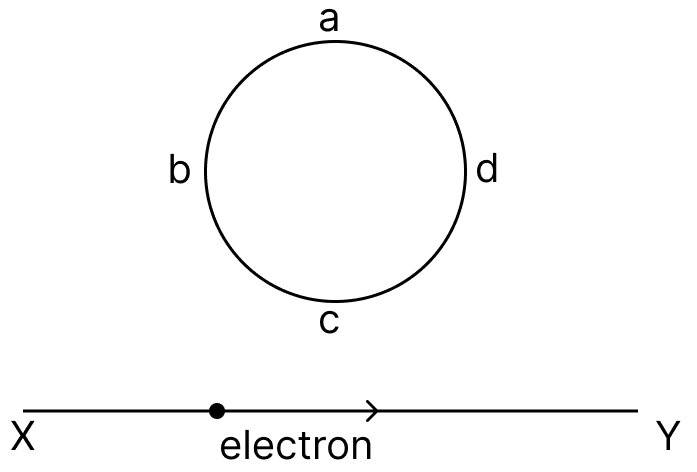
An electron moves on a straight line path XY as shown. abcd is a coil adjacent to the path of electron. The direction of induced current, if any, in the coil will be :
- No curent is induced
- abcd
- adcb
- No fixed direction
The north pole of a magnet is brought near a metallic ring as shown in the figure given below. The direction of induced current will be :

- anticlockwise
- clockwise
- first anticlockwise and then clockwise
- first clockwise and then anticlockwise