Physics
An object is placed in front of a concave lens at a distance of 45 cm from it. If its image is formed at a distance of 30 cm from the lens, calculate the focal length of the lens.
Related Questions
A rectangular glass block of refractive index 1.5 has an air bubble trapped inside it as shown in the diagram. When seen from the surface AB, it appears to be 4 cm deep.
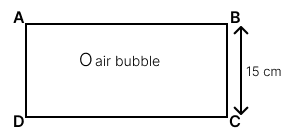
(a) Calculate the actual depth of the air bubble from the surface AB.
(b) For which colour of light, blue or yellow, the apparent depth will be greater?
(c) Turning the glass block upside down, DOES NOT change the apparent depth of the air bubble. State True or False.
(a) An object is placed at 2F position of a convex lens. Draw a ray diagram showing the formation of the image.
(b) How will the size of the image change if we, ONLY replace the lens in the above arrangement with another lens of a greater focal length?
Two rays PQ and RS are incident on a rectangular glass block as shown in the diagram. Observe the diagram and answer the questions that follow.
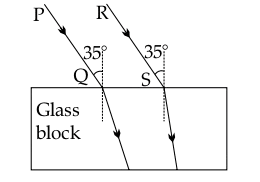
Which of these two rays will :
(a) have greater lateral displacement on emerging out of the block?
(b) travel with greater speed in the block?
(c) scatter more in the atmosphere?
(a) Name the radiations :
- for which a quartz prism is used to study the spectrum.
- which are used in remote sensing devices.
- which are used in traffic signals in India.
(b) Name one property common to all electromagnetic radiations.