
Geography
Observe the image given below and answer the questions that follow.
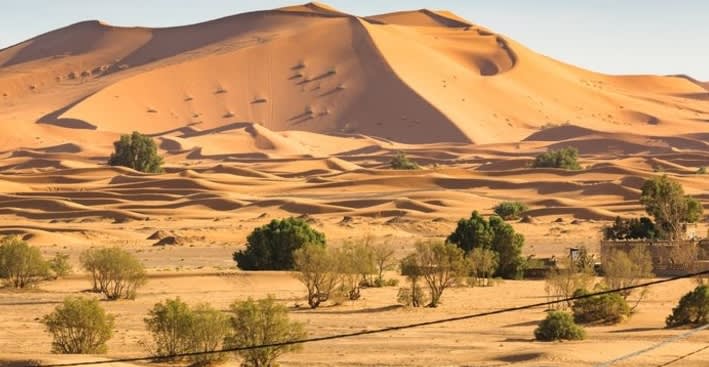
Image 1
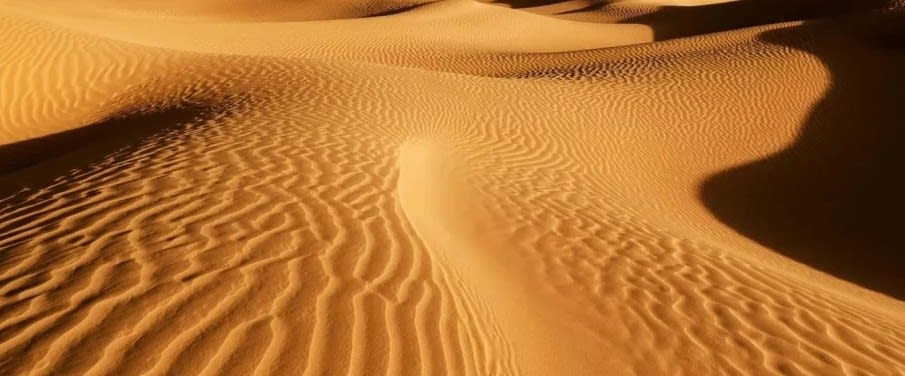
Image 2
Your cousin brother has sent these images to you after visiting Sahara Desert with his family. He was surprised to see the various types of sand dunes found in the desert. From your geographical point of view identify the images sent by your cousin. Also explain why they have different shape?
Weathering
2 Likes
Answer
Image 1 depicts Barkhans.
Barkhan dunes are crescent shaped with horns of crescent trailing downwards. They are caused by accumulation of sand at an obstacle by the prevailing winds, giving them convex and gentle slope at the windward side and are concave and steep at the leeward side. Hence, Barkhan dunes are formed transversely to the direction of winds.Image 2 depicts Seif dunes.
These are long narrow ridges of sand, lying parallel to the direction of prevailing winds. The prevailing dominant winds blow the corridor between the lines of dunes so that they are swept clean of sand and remain smooth. Hence, Seif dunes are formed longitudinally with the direction of winds.
Answered By
2 Likes
Related Questions
Waterfall is formed due to the erosion by which of the following agent?
- Wind
- Underground Water
- River
- Glacier
Which of the following is a static process?
- Erosion
- Weathering
- Denudation
- Solution
One of your friends had visited the Bora cave where she had observed some beautiful features made of limestone inside the cave.
Can you explain the formation process of such limestone topography? Which type of weathering is observed here?
Assertion (A): Barkhans are stationary dunes.
Reason (R): Barkhans are formed transversely with the direction of the winds.
- Both A and R are true and R is the correct explanation of A.
- Both A and R are true and R is not the correct explanation of A.
- A is true but R is false.
- A is false but R is true.