Mathematics
PQR is a right-angled triangle with PQ = 3 cm and QR = 4 cm. A circle which touches all the sides of the triangle is inscribed in the triangle. Calculate the radius of the circle.
Answer
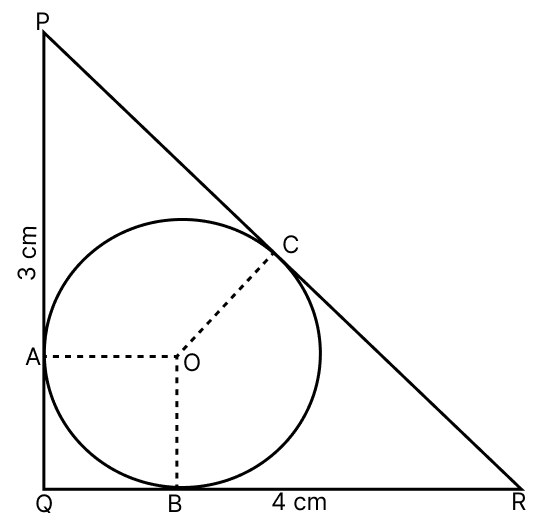
Let the inscribed circle touch the sides PQ, QR and PR at A, B and C respectively.
PQR is a right-angled triangle with PQ = 3 cm and QR = 4 cm.
By pythagoras theorem,
⇒ PR2 = PQ2 + QR2
⇒ PR2 = 32 + 42
⇒ PR2 = 9 + 16
⇒ PR2 = 25
⇒ PR = 5 cm.
By tangent property we have,
∠OAQ = ∠OBQ = 90°
∠AQB = 90°
Since, all the angles of OAQB equals to 90°.
From figure,
OAQB is a square.
OA = OB = AQ = BQ = x (let)
PA = PQ - AQ = (3 - x) cm
PA = PC = (3 - x) cm.[∵ Tangents from exterior point are equal in length.]
RB = RQ - QB = (4 - x) cm
RC = RB = (4 - x) cm.[∵ Tangents from exterior point are equal in length.]
PR = PC + RC = 3 - x + 4 - x = 7 - 2x
5 = 7 - 2x
2x = 7 - 5
2x = 2
x = 1 cm.
Hence, radius of the circle inscribed in the triangle equals to 1 cm.
Related Questions
With the vertices of Δ PQR as centres, three circles are described, each touching the other two externally. If the sides of the triangle are 7 cm, 8 cm and 11 cm, find the radii of the three circles.
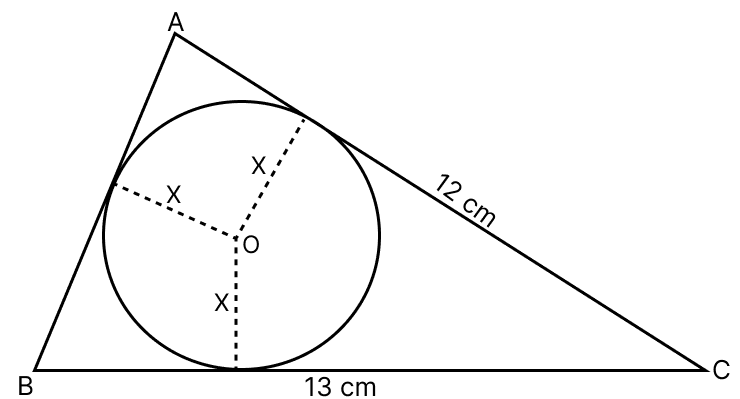
ΔABC is a right-angled triangle in which ∠A = 90°, AC = 12 cm and BC = 13 cm. A circle with centre O has been inscribed inside the triangle. Calculate the value of x, the radius of the inscribed circle.
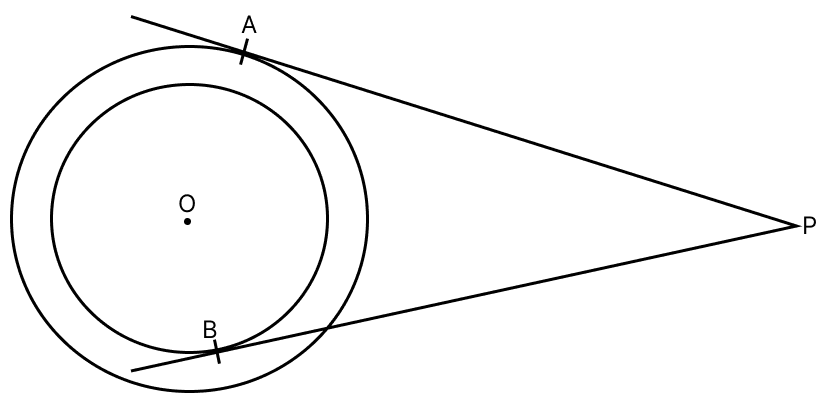
In the given figure, O is the centre of each one of two concentric circles of radii 4 cm and 6 cm respectively. PA and PB are tangents to outer and inner circle respectively. If PA = 10 cm, find the length of PB, upto two places of decimal.
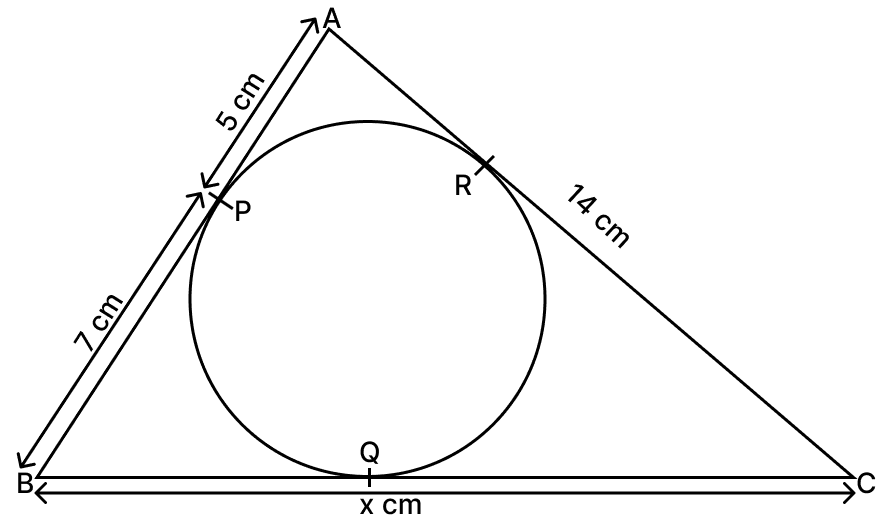
In the given figure, ΔABC is circumscribed. The circle touches the sides AB, BC and CA at P, Q, R respectively. If AP = 5 cm, BP = 7 cm, AC = 14 cm and BC = x cm, find the value of x.