Physics
A ray of light is incident normally on a face of an equilateral prism. The ray gets totally reflected at the second refracting surface. The total deviation produced in the path of the ray is:
- 30°
- 60°
- 90°
- 120°
Answer
60°
Reason — As, the ray is normally incident on face AB so it passes undeviated. Angle of incidence on face AC is 60˚. The reflected ray is incident normally on face BC and passes undeviated.
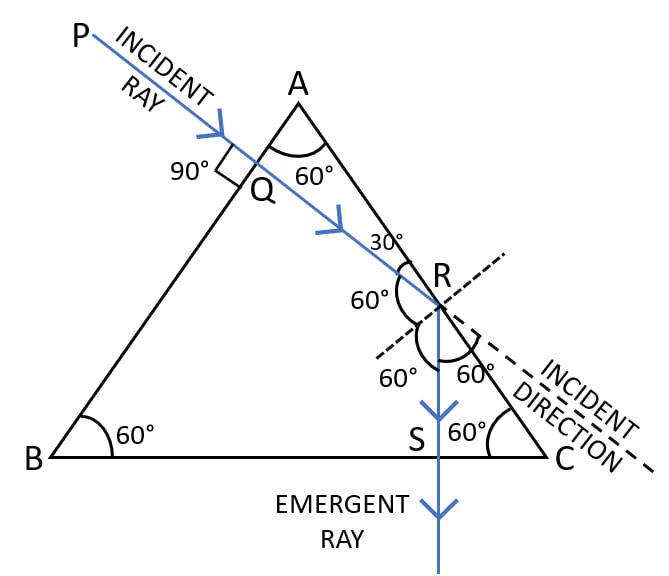
Now, from the above diagram,
∠NRS = 60˚
∴ ∠SRC = 30˚
∠ARQ = 30˚
∴ ∠CRT = 30˚
RT is the original path of the incident ray.
So, total deviation = ∠SRT = 30˚ + 30˚ = 60˚
Related Questions
For a real image formed by a convex lens, the ratio of I : O = 2 : 5, then the object is :
(I is the height of the image and O is the height of the object)
- between O and F
- beyond 2F
- at F
- between F and 2F
In a closed circuit containing a bulb and a cell, the electromotive force (ε) and the terminal voltage (V) is related as.
(Given I is current and r is internal resistance.)
- V = ε + Ir
- V = ε – Ir
- V = ε ÷ Ir
- V = ε × Ir
A metal piece of mass 5 g has thermal capacity 2.5 J K⁻¹. If the mass of the metal is tripled, then its specific heat capacity will be :
- 7.5 J K⁻¹
- 2.5 J K⁻¹
- 1.5 J g⁻¹ K⁻¹
- 0.5 J g⁻¹ K⁻¹