Physics
When a ray of light travels from substance A to substance B and reaches their boundary, it suffers total internal reflection. Out of the following possibilities, which one is correct?
| Angle i | Substance B | |
|---|---|---|
| (a) | i < C | Optical density of A is less than B |
| (b) | i = C | Optical density of A is more than B |
| (c) | i > C | Optical density of A is less than B |
| (d) | i > C | Optical density of A is more than B |
- Option (a)
- Option (b)
- Option (c)
- Option (d)
Related Questions
The condition required for total internal reflection to take place is:
- light ray passes from a rarer to denser medium
- light ray passes from a denser to rarer medium
- angle of incidence is less than critical angle
- none of the above
A scientist while performing an experiment desires that no incident light escapes from the top of a glass block. He varies the angle X continuously and finally manages to achieve his objective. Which of the following options describes the correct answer?
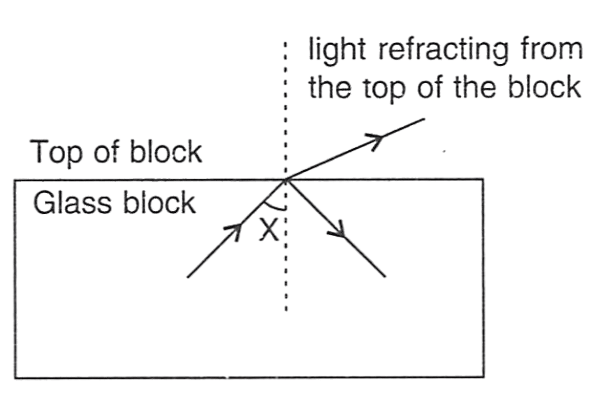
Angle Effect Produced (a) Decreased Total Internal Reflection (b) Decreased Total Internal Refraction (c) Increased Total Internal Refraction (d) Increased Total Internal Reflection - Option (a)
- Option (b)
- Option (c)
- Option (d)
An equilateral prism can be used to deviate a ray of light through:
- 30°
- 60°
- 75°
- 90°
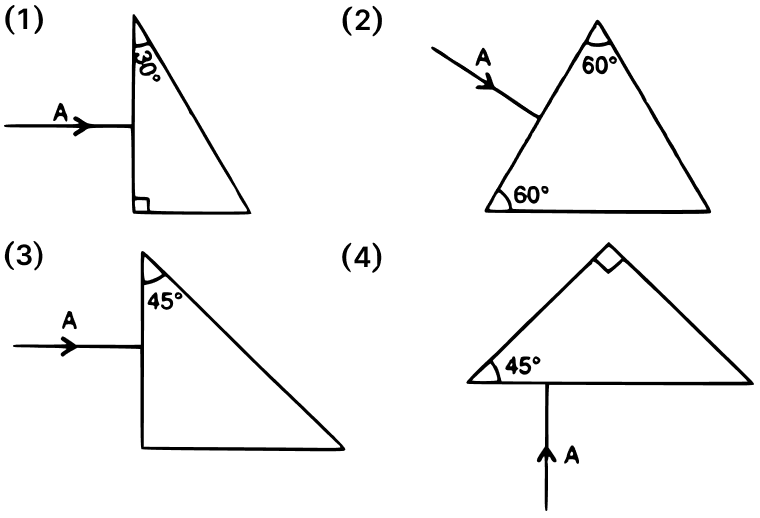
Which of the following figures will depict deviation of ray of light A through 180°